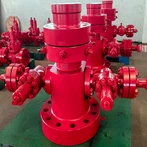
The Positive Displacement Motor (PDM), commonly known as a mud motor or Positive Displacement Motor (PDM), is a volumetric downhole power tool that converts the hydraulic energy of drilling fluid into mechanical rotation. Widely used in directional drilling, horizontal wells, and straight-hole applications, the PDM enables precise control of bit rotation without rotating the entire drill string from surface.
Basic Principle
A PDM is powered by drilling fluid (mud) pumped from the surface mud pumps. As the fluid flows through a bypass valve and enters the motor section, a pressure differential develops across the motor's inlet and outlet. This pressure drop drives the rotor to rotate eccentrically within the stator. The rotational speed and torque are transmitted through a universal joint (flex shaft) and a drive shaft assembly to the drill bit, enabling drilling operations.
Main Components
A PDM consists of four major assemblies:
- Bypass Valve
- Hydraulic Motor (Stator and Rotor)
- Universal Joint (Flex Shaft)
- Drive Shaft Assembly
1. Bypass Valve
The bypass valve comprises a valve body, valve sleeve, valve core, and spring. Under the action of fluid pressure, the valve core slides within the sleeve, changing the flow path. The valve has two states:
- Bypass State (Open): During tripping in or out (when mud flow is low or stopped), the spring pushes the core up, opening the bypass ports. Mud in the drill string bypasses the motor and exits into the annulus.
- Closed State: When the mud flow rate and pressure reach a set value, the core shifts down, closing the bypass ports. All mud then flows through the motor, converting pressure energy into mechanical rotation.
2. Motor Section (Stator & Rotor)
The motor is the core component of the PDM.
Stator: A steel tube with an elastomer (rubber) lining molded into a helical shape with specific geometric parameters.
Rotor: A hard-coated steel helical screw (typically chrome-plated or hard-faced) that engages with the stator.
The rotor and stator form a series of sealed cavities. As mud pressure forces the rotor to turn eccentrically within the stator, the rotation is transmitted to the bit. A single helical pitch (one complete thread) equals one stage. For efficient operation, the pressure drop per stage should not exceed 0.8 MPa (approximately 116 psi); beyond this, internal leakage (slippage) increases, rotor speed drops sharply, and motor damage may occur.
Performance Characteristics:
- Theoretical output torque is proportional to motor pressure drop.
- Output rotational speed (RPM) is proportional to input mud flow rate.
- As load (bit torque) increases, motor speed decreases.
By monitoring surface pump pressure and flow rate, the driller can effectively control downhole torque and RPM.
Rotor Lobes (Threads): Rotors can be single-lobe or multi-lobe.
- Fewer lobes (e.g., 1:2) → Higher RPM, lower torque.
- More lobes (e.g., 7:8) → Lower RPM, higher torque (ideal for high-torque applications like horizontal drilling).
3. Universal Joint (Flex Shaft)
The universal joint converts the planetary (eccentric) motion of the rotor into concentric (axial) rotation for the drive shaft. Most modern PDMs use a flexible shaft (flex-shaft) design for reliability and compactness.
4. Drive Shaft Assembly
The drive shaft transmits the rotation and torque from the universal joint to the drill bit. It also bears the axial (weight-on-bit) and radial loads encountered during drilling. Therefore, drive shafts require high hardness, excellent wear resistance, and long service life. Heat treatment (quenching and tempering) is commonly applied to significantly extend the service life of drive shaft components.
Operational Guidelines
- Flow Rate: The actual mud flow rate must remain within the manufacturer's recommended range. Excessive flow can accelerate wear; insufficient flow reduces motor efficiency.
- Pressure Drop: Monitor the pressure drop across the motor. A sudden increase or erratic behavior may indicate motor stalling or internal damage.
- Starting Torque: Initial breakaway torque may be higher than running torque; operators should slowly apply load.
Applications
PDMs are essential for:
- Directional and horizontal drilling (with bent housing).
- Sidetracking and re-entry drilling.
- Coiled tubing drilling.
- Straight-hole drilling where controlled bit speed is desired.
The Positive Displacement Motor is a mature, reliable downhole tool that transforms hydraulic power into mechanical rotation, enabling efficient drilling in vertical, deviated, and horizontal wells. Understanding its components-bypass valve, motor (stator/rotor), universal joint, and drive shaft-as well as the relationships between flow rate, pressure drop, torque, and speed, is fundamental for optimizing drilling performance and preventing downhole failures. Advances in elastomer technology, rotor coating, and heat treatment of drive shafts continue to expand the operational envelope of PDMs in high-temperature, high-torque, and demanding drilling environments. For more detailed information, please don't hesitate to contact Vigor team for more detailed product information.