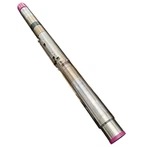
Managing an ultra-high-temperature, high-pressure well without production logging is like flying on instruments with the displays dark. When several intervals are commingled, a rising water cut could originate from one zone or three, and a falling wellhead pressure could signal depletion, crossflow, or a developing restriction. In wells exceeding 175 degrees Celsius and 100 MPa, the logging tools themselves become the limiting factor: electronics, seals, and sensors must withstand both ambient heat and the thermal shock of repeated runs. The global production logging tools market is estimated at approximately USD 3.5 billion in 2026 and is projected to grow at a CAGR of about 6 percent through the mid-2030s, with high-temperature, high-pressure tool strings among the fastest-growing segments. The ultra-HTHP production logging tool (VUPT) is engineered specifically to close that data gap in extreme wells.
Production Profiling With the Ultra-HTHP Production Logging Tool
A production profile answers a deceptively simple question: which intervals contribute what, in which phase, and at what pressure? The tool string integrates flowmeters, pressure and temperature sensors, fluid density and water-holdup measurements, plus gamma ray and casing-collar correlation for depth control. All sensors run as one synchronized string so that flow, pressure, and fluid-property data share a common depth and time base. Downhole interpretation then allocates production across perforated intervals, identifies unwanted water or gas entry, and detects crossflow between zones - information that surface measurements alone cannot resolve because they aggregate everything into a single flowstream.
Flow rate, pressure, temperature, and holdup are acquired simultaneously on a common depth reference
Zonal allocation quantifies each interval's contribution to total production
Calibration and Quality Assurance at High Temperature
Data from an extreme environment is only as trustworthy as the calibration behind it. Before deployment, sensors are verified against reference standards: flowmeters are checked in flow loops across their operating range, pressure gauges against traceable standards, and temperature sensors against known fixed points. Temperature-compensation curves correct measurements across the operating envelope, because a sensor calibrated at 25 degrees Celsius cannot simply be trusted at 200 degrees. Each run is bracketed by surface verification checks, and drift between the before-and-after checks is documented, so the engineer knows the uncertainty attached to every number in the log.
Repeat-Survey Reliability in HP/HT Wells
The value of surveillance compounds with repetition: a single snapshot shows today's condition, but trend analysis shows how the well is changing. That demands tools that return consistent measurements run after run. In HP/HT service the stress is cumulative - seals and connectors are thermally cycled, electronics are repeatedly brought to high temperature, and housings are pressure-cycled. A typical deep HP/HT gas well may be surveyed several times across a five-year field life, making tool repeatability an economic as well as technical requirement. Tool design therefore emphasizes thermal stability of the sensor section, robust sealing architectures, and component screening before assembly, while maintenance programs replace consumable seals and re-verify calibration between jobs. The result is a measurement baseline stable enough to compare a survey from one year against the next.
Building a Surveillance Program Around the Ultra-HTHP Production Logging Tool
With a tool that can run in extreme conditions, operators can schedule logging as routine surveillance rather than a response to trouble. Baseline surveys after completion establish the reference profile; periodic repeat surveys track water breakthrough, gas coning, and pressure depletion; and targeted runs before workovers define the intervention scope. Conveyance flexibility matters here - the tool can run in memory mode on slickline or coiled tubing in wells where rig time is scarce, avoiding a full workover simply to gather data. The economics shift accordingly: logging becomes a planned cost of reservoir management, not an emergency expense.
For ultra-HTHP wells, reliable production logging transforms reservoir management from guesswork into measurement. The ultra-HTHP production logging tool (VUPT) from China Vigor combines synchronized sensor strings, rigorous calibration, and repeat-survey reliability, giving operators the data to allocate production, detect problems early, and plan interventions with confidence.
For more information, please contact China Vigor at info@vigorpetroleum.com or call +0086 29 81161513.