How do you know when it is time for a wellbore cleanout in a mature well? Should it be a regular & ongoing process or it is not necessary?
Schlumberger: When the wells production beings to drop, and it is confirmed that the production drop is as a result of solids/sand/scale accumulation in the wellbore, an economic analysis needs to be performed to compare the cost of a cleanout and the production gain to be achieved from the cleanout to determine the timing of a cleanout. In order to avoid the initial production drop and maximize the production from the well, cleanouts should be done regularly particularly if they are from scale build up or debris accumulation.
Baker Hughes: In a mature well, wellbore cleanout is often performed before, during or after any workover operations if it makes sense economically. The examples include cleanout the debris off a safety valve to ensure the proper function of the valve, removing the debris when retrieving or milling a packer or plug, casing ID preparation before a casing exit or plug setting operations.
Halliburton: To identify the wells that need cleanouts, we have to continuously watch production figures. For instance, the following factors are important:
Look for anomalous and steepening decline rates that do not fit predicted production rates.
One test could be a pressure fall off survey to determine skin value.
Look for wells that are acidized often.
Look for wells that require periodic maintenance.
Routine asphaltene and paraffin cleanouts can indicate a problem especially if hot oiling has been done downhole.
Are fluid levels as expected in the well (shoot fluid levels to determine).
Wells can be filled with scale, iron sulfide, salt, sand, or other solids which can be determined by running a simple sinker bar – these wells are cleanout and/or acidization candidates. GIS results could be very helpful in identifying the problem.
What types of wellbore cleanout solutions do you have?
Schlumberger: Schlumberger has many different wellbore cleanout solutions in its arsenal that are fit for purpose, comprising of mainly mechanical tools for milling and scraping, hydraulic tools for jetting and flow back, as well as chemical fluid systems for an effective cleanout through dissolution or viscous solids carrying capabilities. Integration of all these different solutions with a state of the art wellbore cleanout design software and real-time monitoring of key downhole parameters (differential pressure, temperature, casing collar locator (CCL), gamma ray (GR), downhole load) with the ACTive* fiber optic enabled coiled tubing (CT) system, enables the confidence to achieve efficient and optimized wellbore cleanouts.
Baker Hughes: Baker Hughes provides complete wellbore cleanout and displacement solutions, including mechanical tools, chemicals and engineering services. Baker Hughes X-Treme CleanTM mechanical wellbore cleanup and displacement system provides the most complete wellbore cleanout tools in the industry; it includes Riser and BoP cleanout tools, casing ID cleanout tools, junk removal tools, circulation tools, and etc for different applications from land to deepwater. VACS is one of Baker Hughes leading technology. It effectively collects debris downhole, especially in difficult or extreme well conditions. We also provide chemical solutions that are fit for purpose, have outstanding performance and meet the environmental requirements. The displacement fluids include MICRO-PRIMETM, BAKER CLEANTM and WELL WASHTM. By deploying the advanced analysis and simulation tools, such as DISPLEXTM, Torque and Drag, VACSPredictorTM we can further assist the customers to ensure the success of any wellbore cleanup and displacement job.
Halliburton: Halliburton's Multi-Chem business line can provide a complete customized wellbore cleanout service with a combination of chemicals and equipment. This includes:
Scale removals
Wax and asphaltene removals
Foamers for cleanout operations
Biocides to remove biofilms
AcroClear iron sulfide removal
Foamers to unload gas wells
Surfactants
Chemical package for acid job operations, etc.
Mutual solvents for fines displacement and wettability control
Clay swelling control products
Monitoring Service for results
Coiled tubing for application (Boots & Coots)
Hydra-Blast for cleanouts
Pulsonix TFA for cleanout
CoilSweep for cleanouts
DeepReach for application
Monitoring for services
Pinpoint placement of application
Pumping services
Frac services as needed
How do the solutions on the market differ in terms of the key issues they solve?
Schlumberger: Efficiency is essential in optimizing production from aging oil fields and reservoirs that are difficult to produce. By understanding the interrelationships and potential synergies in process elements, new technologies emerge, helping operators return wells to production faster. As non productive time decreases, costs decrease and field output increases.
Understanding key process elements is not always straightforward, and often requires the insights of experts from diverse disciplines. For example, chemists generally develop cleanout fluids, while mechanical engineers and fluid mechanics specialists develop nozzle technology; the Schlumberger ACTive service with integrated wellbore cleanout system exemplifies this type of multidisciplinary collaboration. Schlumberger engineers have the tools and computing support to quickly model, perform multiple iterations and optimize cleanout system performance for most wellbore conditions and requirements, all in real-time while intervening in the wellbore – where it matters the most! This solution allows operators to perform cleanouts in underbalanced conditions, large wellbores, or wells that are highly deviated or horizontal.
Baker Hughes: Most operators and service providers share the basic wellbore cleanout concepts and practice. Mechanical tools and chemicals are combined to provide the best results. However, there are differences in tool and chemical designs and functions, and detailed operation procedures among difference companies. For example, many service providers, including Baker Hughes, believe in non-rotation (the scraper blades or brushes that have direct contact with the casing ID do not rotate with the casing string) wellbore cleanup tool design to avoid any damage to casing ID, while others use rotational design. In general, there is increasing focus on wellbore cleanout operations in the industry, and the operators and service companies have been working together to drive the most effective cleanout products and services to reduce the costs and NPT.
Halliburton: The solutions for wellbore cleanout are different in respect to the chemicals and fluids from which solvents are made. Both hydraulic and chemical cleanouts are accomplished by circulating fluids in the well but the choice of chemical reagents depends on the problem to be solved. So, we prepare individual cleanout programs for each well. In many cases, the chemical solution could be the only possible or the most cost efficient way to fix the problem.
Solutions should be customized to the problem to be solved. In that view it is important to determine the causes of the well problems. Use of the wrong treatment may create more damage (hot oil, acid), fail to correct the problem, treat the wrong problem, or be either excessive or un-needed, all causing lost time, production, and money. Not understanding root causes of the problem can result in not solving the problem by use of continuous remedial actions (i.e., multiple scale removals in a well not considering a scale inhibitor squeeze to prevent the scale problem) or repeating the cause of the damage (hot oil or acidizing). For example, use of acid to increase production, although successful, may not be addressing the real issue. Analysis of the returning fluids form the acid job would indicate if scale was being dissolved (increase in calcium and loss of acid). If this calcium increase and loss of acid was not happening then perhaps just fines were being displaced from the wellbore and the use of acid (or acid concentration) would not be needed.
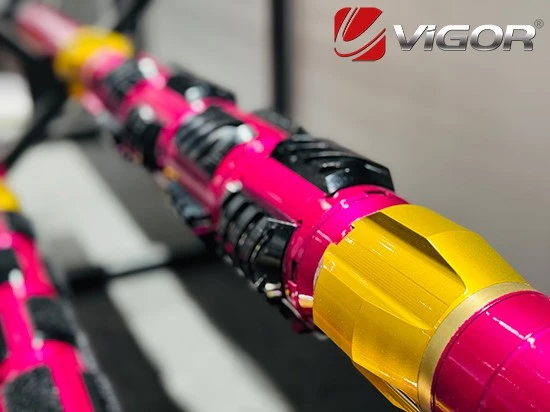
Certain downhole debris, like cement, heavy fill, or compacted sand, demands specialized tools beyond standard scrapers or jets. Vigor dedicates resources to sourcing and developing advanced solutions such as milling tools, aggressive broaches, or high-torque motors for these challenging scenarios. Our extensive technical and supplier network ensures we can address the toughest cleanout problems encountered in the field. Vigor's willingness to tackle difficult jobs with specialized equipment has earned us significant respect from leading global customers. Don't let stubborn debris compromise your well. Vigor has the specialized tools. Contact us for challenging cleanouts. For more information, you can write to our mailbox info@vigorpetroleum.com & mail@vigorpetroleum.com.