


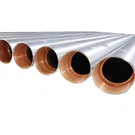


Hey there! As a supplier of SAW OCTG (Submerged Arc Welded Oil Country Tubular Goods), I'm super stoked to chat about the quality control measures in SAW OCTG production. It's a topic that's not only crucial for us suppliers but also for our clients who rely on top - notch products for their oil and gas operations.
Let's start with the raw materials. The quality of SAW OCTG begins right at the source. We use high - grade steel plates for the production. Before we even start cutting and shaping, we conduct a series of tests on these plates. Chemical composition analysis is a must. We check the amounts of elements like carbon, manganese, sulfur, and phosphorus. These elements play a huge role in determining the mechanical properties of the final product. For instance, too much sulfur can make the steel brittle, which is a big no - no in the high - pressure environment of oil wells. We use advanced spectrometers to get accurate readings of these elements.
Next up is the mechanical properties test. We cut samples from the steel plates and perform tensile tests. These tests tell us how much stress the steel can handle before it breaks or starts to deform permanently. We also do Charpy impact tests. This test involves hitting a notched sample of the steel with a pendulum. It helps us understand how the steel will perform in low - temperature or impact - prone situations, which are common in oil and gas fields.
Once we're satisfied with the quality of the raw materials, it's time for the welding process, which is the heart of SAW OCTG production. The submerged arc welding technique is a precise process. We use automated welding machines that are set at specific parameters. The welding current, voltage, and wire feed speed are carefully controlled. Any deviation from these parameters can result in a weak weld, which can compromise the integrity of the entire OCTG.
To ensure the quality of the welds, we use non - destructive testing (NDT) methods. Ultrasonic testing (UT) is one of the most common techniques. It uses high - frequency sound waves to detect internal flaws in the weld, such as cracks or porosity. We also use magnetic particle testing (MT) for welds made of ferromagnetic materials. MT can quickly find surface and near - surface defects. And for more comprehensive inspection, we sometimes use radiography. This method uses X - rays or gamma rays to produce an image of the weld on a film, allowing us to spot any hidden imperfections.
After the welding is done, we head to the sizing and straightening process. The SAW OCTG needs to have precise dimensions to fit properly in the oil well operations. We use sizing machines to ensure that the diameter and wall thickness of the pipes are within the specified tolerances. Then, we straighten the pipes to make sure they are not bent or warped. Any curvature in the pipes can cause problems during installation and operation.
Once the pipes are sized and straightened, we move on to the heat treatment phase. Heat treatment is essential to improve the mechanical properties of the SAW OCTG. We can increase the hardness, strength, and toughness of the pipes through processes like quenching and tempering. But just like with the welding, we need to control the temperature and time accurately during heat treatment. Any mistakes here can lead to inconsistent mechanical properties across the pipes.
Surface finishing is also an important part of quality control. We clean the pipes to remove any scale, rust, or welding slag. A smooth surface not only improves the appearance of the pipes but also reduces the risk of corrosion. After cleaning, we sometimes apply a protective coating to the pipes. This coating can be an epoxy, polyethylene, or other corrosion - resistant materials. It acts as a barrier between the pipe and the harsh environment in the oil well.
Now, let's talk about some of the products we offer as part of our SAW OCTG line. We have Special Clearance Coupling. These couplings are designed to meet specific clearance requirements in oil well operations. They are made with the same high - quality standards as our pipes, going through all the quality control measures we've discussed.


Our Tubing is another key product. Tubing is used to transport oil and gas from the well to the surface. It needs to be highly resistant to corrosion and pressure. That's why we put our tubing through rigorous testing to ensure it can withstand the tough conditions in the oil fields.
We also supply Line Pipe. Line pipes are used to transport oil and gas over long distances. They need to have excellent weldability and mechanical properties. Our quality control measures ensure that our line pipes are reliable and long - lasting.
In addition to these in - house quality control measures, we also adhere to international standards and certifications. We work closely with organizations like API (American Petroleum Institute) and ISO (International Organization for Standardization). These standards provide a framework for our production processes and quality control. By meeting these standards, we can assure our clients that our SAW OCTG products are of the highest quality.
We also have a team of experienced quality control inspectors. These inspectors are on the production floor all the time, monitoring every step of the process. They can catch any potential problems early and take corrective actions immediately. They perform random checks at different stages of production, and they also do a final inspection before the products are shipped out.
As a SAW OCTG supplier, we understand that the quality of our products is directly related to the success of our clients' operations. A single defective pipe can lead to costly downtime and safety issues in the oil and gas fields. That's why we're so strict with our quality control measures.
If you're in the market for high - quality SAW OCTG products, we'd love to start a conversation. Whether you need tubing, line pipes, or special clearance couplings, we've got you covered. Our quality control measures ensure that you'll get products that meet your requirements and exceed your expectations. So, don't hesitate to reach out for a procurement discussion. We're here to make sure you get the best SAW OCTG for your projects.
References
- American Petroleum Institute (API) standards related to OCTG
- International Organization for Standardization (ISO) documents on quality control in steel pipe production