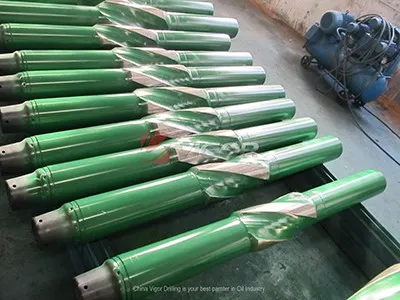
A drilling stabilizer is an important piece of equipment used in the bottom hole assembly (BHA) of a drill string. Its primary function is to mechanically stabilize the BHA in the borehole, preventing unintentional sidetracking and vibrations that can compromise the quality of the hole being drilled.
The drilling stabilizer consists of a hollow cylindrical body and stabilizing blades, both made from high-strength steel. The blades can be either straight or spiraled, and are hardfaced for wear resistance. This design ensures that the stabilizer can withstand the harsh conditions of drilling without wearing down quickly.
There are several types of drilling stabilizers used in the oilfield today. The most common type is the integral stabilizer, which is fully machined out of a single piece of steel. However, there are other types that can be used depending on specific drilling scenarios.
One such type is the replaceable sleeve stabilizer, where the blades are located on a sleeve that can be screwed onto the body. This type of stabilizer is economical when repair facilities are not readily available near the drilling site, as it allows for easy replacement of worn parts without having to transport the entire stabilizer.
Another type is the welded blades stabilizer, where the blades are welded onto the body. While this type is generally not recommended for use in oil wells due to the risk of losing blades, it is commonly used in water wells or low-cost oilfields where the risks are deemed acceptable.
In most cases, 2 to 3 stabilizers are fitted into the BHA. One stabilizer is placed just above the drill bit (near-bit stabilizer), while one or two stabilizers are positioned among the drill collars (string stabilizers). This arrangement helps to maintain stability throughout the entire drilling process, ensuring accurate and efficient hole drilling.
Overall, drilling stabilizers play a crucial role in modern drilling operations by providing mechanical stability and minimizing unintentional sidetracking and vibrations. Their design and functionality have evolved over time to meet the demands of different drilling scenarios, making them an essential component in any drill string's bottom hole assembly.