


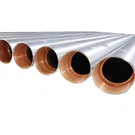


Hey there! As a supplier of 4" Casing, I've been getting a lot of questions recently about whether 4" Casing needs to be inspected regularly. It's a super important topic, and I'm excited to share my insights with you.
First off, let's talk about what 4" Casing is. It's a type of pipe that's commonly used in oil and gas wells. Its main job is to provide structural support to the wellbore, prevent the collapse of the surrounding rock, and isolate different geological formations. This helps in ensuring the safety and efficiency of the whole drilling process.


Now, to answer the big question: Does 4" Casing need to be inspected regularly? The short answer is yes, and here's why.
One of the key reasons for regular inspections is corrosion. In the harsh environments of oil and gas wells, 4" Casing is often exposed to various corrosive substances like hydrogen sulfide, carbon dioxide, and saltwater. Over time, these substances can eat away at the casing, weakening its structure. If this corrosion goes undetected, it can lead to leaks, which are not only a safety hazard but can also cause significant environmental damage. By inspecting the casing regularly, we can catch early signs of corrosion and take steps to prevent further deterioration. This might involve applying protective coatings, cathodic protection, or even replacing the damaged sections.
Another factor is mechanical damage. During the installation and operation of the well, the 4" Casing can be subject to all sorts of mechanical stresses. Things like impacts during transportation, handling, or the forces exerted during the drilling process can cause dents, scratches, or even cracks in the casing. These defects can compromise the integrity of the casing and make it more prone to failure. Regular inspections allow us to identify any mechanical damage and assess its severity. Depending on the situation, we might be able to repair the damage or, if necessary, replace the affected parts.
In addition to corrosion and mechanical damage, the casing can also be affected by changes in the wellbore conditions. For example, the pressure and temperature inside the well can fluctuate, which can cause the casing to expand or contract. Over time, these thermal and pressure cycles can lead to fatigue and stress cracking. By inspecting the casing regularly, we can monitor these changes and take appropriate measures to ensure the long - term performance of the casing.
As a 4" Casing supplier, I've seen firsthand the importance of regular inspections. We always recommend our clients to have a comprehensive inspection plan in place. But what does a typical inspection involve?
Well, there are several different methods that can be used to inspect 4" Casing. One common method is magnetic flux leakage testing. This technique uses a magnetic field to detect any changes in the magnetic properties of the casing. If there are any defects like cracks or corrosion, they will disrupt the magnetic field, and this can be detected by the testing equipment. Another popular method is ultrasonic testing. This involves sending high - frequency sound waves through the casing. When the sound waves encounter a defect, they reflect back, and the time it takes for the waves to return can be used to determine the location and size of the defect.
There are also visual inspections. While this might seem old - fashioned, it's still an important part of the inspection process. A visual inspection can help identify any obvious signs of corrosion, damage, or misalignment. Inspectors can use tools like cameras and mirrors to get a closer look at hard - to - reach areas.
Now, I know that regular inspections might seem like a hassle and an added cost. But let me tell you, the cost of not inspecting the casing regularly can be much higher. A casing failure can lead to production downtime, costly repairs, and potential legal and environmental liabilities. By investing in regular inspections, you're actually saving money in the long run.
If you're in the market for high - quality 4" Casing, we've got you covered. We offer different types of 4" Casing to meet your specific needs. For example, our Premium Connection is a great option for wells that require a high - integrity connection. It provides excellent sealing performance and can withstand high pressures and temperatures.
We also have CRA Pipe, which is made from corrosion - resistant alloys. This is ideal for wells with highly corrosive environments. And if you need a casing that allows for fluid flow, our Slotted Casing is a perfect choice. It has slots that allow the fluid to enter or exit the wellbore, while still providing the necessary structural support.
So, if you're interested in our 4" Casing products or have any questions about casing inspections, don't hesitate to reach out. We're here to help you make the best decisions for your well operations. Whether you're a small - scale drilling company or a large - scale oil and gas producer, we can provide you with the right casing solutions and support.
In conclusion, regular inspection of 4" Casing is a must. It helps ensure the safety, efficiency, and longevity of your well. As a reliable supplier, we not only offer top - quality casing but also have the knowledge and expertise to assist you in maintaining your well infrastructure. So, let's work together to keep your wells running smoothly.
References
- API RP 5C5: Recommended Practice for Calculation of Performance Properties of Casing, Tubing, Drill Pipe, and Line Pipe
- ISO 13679: Petroleum and natural gas industries - Casing and tubing - Connecting thread evaluation by full - scale testing
- NACE MR0175/ISO 15156: Petroleum and natural gas industries - Materials for use in H2S - containing environments in oil and gas production