


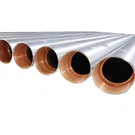


The oil and gas industry relies heavily on Oil Country Tubular Goods (OCTG) for various applications, including drilling, production, and transportation. Among the many factors that influence the performance of OCTG, the internal diameter (ID) tolerance plays a crucial role in determining its flow capacity. As an OCTG supplier, I have witnessed firsthand how even minor variations in ID tolerance can have a significant impact on the efficiency and effectiveness of these tubular products. In this blog post, I will delve into the relationship between the internal diameter tolerance of OCTG and its flow capacity, exploring the scientific principles behind it and discussing the practical implications for the industry.
Understanding Internal Diameter Tolerance in OCTG
Before we can understand how ID tolerance affects flow capacity, it is essential to define what we mean by internal diameter tolerance. In the context of OCTG, the internal diameter refers to the measurement of the inside of the pipe, while the tolerance is the allowable deviation from the specified nominal diameter. For example, if a pipe has a nominal ID of 4 inches with a tolerance of ±0.01 inches, the actual ID of the pipe can range from 3.99 inches to 4.01 inches.
The ID tolerance is typically specified by industry standards, such as the American Petroleum Institute (API) standards, which provide guidelines for the manufacturing and quality control of OCTG. These standards ensure that the pipes meet the required specifications for various applications, including flow capacity. However, achieving precise ID tolerances can be challenging due to factors such as manufacturing processes, material properties, and environmental conditions.


The Science Behind Flow Capacity in OCTG
Flow capacity refers to the ability of a pipe to transport fluids, such as oil, gas, or water, from one point to another. It is determined by several factors, including the internal diameter of the pipe, the length of the pipe, the viscosity of the fluid, and the pressure difference across the pipe. According to the Hagen-Poiseuille equation, the volumetric flow rate (Q) of a fluid through a cylindrical pipe is directly proportional to the fourth power of the internal diameter (D) and the pressure difference (ΔP) and inversely proportional to the viscosity (μ) of the fluid and the length (L) of the pipe:
Q = (π * D^4 * ΔP) / (128 * μ * L)
This equation shows that even a small change in the internal diameter can have a significant impact on the flow capacity of the pipe. For example, if the internal diameter of a pipe is reduced by 10%, the flow capacity will be reduced by approximately 34% (assuming all other factors remain constant). This highlights the importance of maintaining tight ID tolerances to ensure optimal flow performance.
How ID Tolerance Affects Flow Capacity
The internal diameter tolerance of OCTG can affect its flow capacity in several ways. Firstly, variations in ID can lead to changes in the cross-sectional area of the pipe, which directly impacts the flow rate. A smaller ID will result in a smaller cross-sectional area, reducing the amount of fluid that can flow through the pipe. Conversely, a larger ID will increase the cross-sectional area, allowing for a higher flow rate.
Secondly, ID tolerance can also affect the flow regime within the pipe. In laminar flow, the fluid moves in parallel layers with minimal mixing, while in turbulent flow, the fluid moves in a chaotic manner with significant mixing. The transition from laminar to turbulent flow is influenced by the Reynolds number, which is a dimensionless quantity that depends on the fluid velocity, the internal diameter of the pipe, and the fluid viscosity. A smaller ID can increase the Reynolds number, leading to a transition from laminar to turbulent flow, which can result in higher frictional losses and reduced flow capacity.
Thirdly, ID tolerance can also affect the pressure drop across the pipe. According to the Darcy-Weisbach equation, the pressure drop (ΔP) in a pipe is directly proportional to the frictional factor (f), the length (L) of the pipe, the fluid density (ρ), the square of the fluid velocity (V^2), and inversely proportional to the internal diameter (D) of the pipe:
ΔP = f * (L / D) * (ρ * V^2 / 2)
A smaller ID will increase the pressure drop, which can require higher pumping power to maintain the desired flow rate. This can result in increased energy consumption and operating costs.
Practical Implications for the Industry
The impact of ID tolerance on flow capacity has several practical implications for the oil and gas industry. Firstly, it can affect the efficiency and productivity of oil and gas wells. If the flow capacity of the OCTG is reduced due to ID variations, it can result in lower production rates and increased downtime for maintenance and repairs. This can have a significant impact on the profitability of the well.
Secondly, ID tolerance can also affect the safety and reliability of the oil and gas infrastructure. If the flow capacity of the pipes is not sufficient to handle the required fluid volume, it can lead to overpressure situations, which can cause pipe failures and potentially hazardous conditions. This highlights the importance of ensuring that the OCTG meets the required ID tolerances to ensure the safe and reliable operation of the infrastructure.
Thirdly, ID tolerance can also affect the cost of the oil and gas operations. If the flow capacity of the pipes is reduced, it may be necessary to install larger diameter pipes or additional pumping equipment to maintain the desired flow rate. This can result in increased capital expenditure and operating costs. Therefore, it is essential to optimize the ID tolerance of the OCTG to minimize costs while ensuring optimal flow performance.
As an OCTG Supplier
As an OCTG supplier, we understand the importance of providing high-quality products that meet the required ID tolerances. We use advanced manufacturing processes and quality control measures to ensure that our pipes have consistent internal diameters within the specified tolerances. Our state-of-the-art facilities are equipped with the latest technology to measure and monitor the ID of the pipes during the manufacturing process, allowing us to detect and correct any deviations in real-time.
In addition to manufacturing high-quality OCTG, we also offer a range of value-added services to our customers. Our technical experts can provide guidance on the selection of the appropriate OCTG based on the specific application requirements, including flow capacity. We can also assist with the installation and maintenance of the pipes to ensure optimal performance and longevity.
We also offer a variety of OCTG products, including Flow Coupling, Pup Joint, and Cold Rolled Pipe. These products are designed to meet the diverse needs of the oil and gas industry and are available in a range of sizes and specifications to suit different applications.
Conclusion
In conclusion, the internal diameter tolerance of OCTG plays a crucial role in determining its flow capacity. Even minor variations in ID can have a significant impact on the efficiency, productivity, safety, and cost of oil and gas operations. As an OCTG supplier, we are committed to providing high-quality products that meet the required ID tolerances and offer value-added services to our customers. If you are in the market for OCTG, we encourage you to contact us to discuss your specific requirements and learn more about how we can help you optimize your flow performance.
References
- American Petroleum Institute (API). API Spec 5CT, Specification for Casing and Tubing.
- Bird, R. B., Stewart, W. E., & Lightfoot, E. N. (2007). Transport Phenomena (2nd ed.). Wiley.
- Incropera, F. P., & DeWitt, D. P. (2002). Fundamentals of Heat and Mass Transfer (5th ed.). Wiley.