


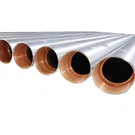


Hey there! As a supplier of 7" casing, I know how crucial it is to ensure the integrity of these products. In the oil and gas industry, 7" casings play a vital role in well construction, providing structural support and preventing the collapse of the wellbore. So, today I'm gonna share some practical ways to test the integrity of 7" casing.
Visual Inspection
The first step in testing the integrity of 7" casing is a simple yet effective visual inspection. This is like the basic health check - up for the casing. You start by looking at the exterior of the casing. Check for any visible signs of damage such as cracks, dents, or corrosion. Cracks can significantly weaken the casing and may lead to failure under pressure. Dents can also cause stress concentrations, which might eventually result in structural integrity issues.
Corrosion is another big concern. It can eat away at the casing material over time, reducing its thickness and strength. Look for rust - colored patches or areas where the paint or coating has peeled off. Sometimes, you can also use a magnifying glass to get a closer look at small surface irregularities.
Ultrasonic Testing
Ultrasonic testing is a non - destructive testing method that's widely used in our industry. It works by sending high - frequency sound waves into the casing wall. These sound waves travel through the material and bounce back when they encounter a defect like a crack or a void.
To perform ultrasonic testing, you use a specialized ultrasonic testing device. The technician places a transducer on the surface of the casing. The transducer emits the sound waves, and then it receives the echoes. By analyzing the time it takes for the echoes to return and their amplitude, you can determine the location and size of any internal defects.
This method is great because it can detect flaws that aren't visible to the naked eye. It's also relatively quick and can be done in the field. However, it does require a trained operator to accurately interpret the results.
Magnetic Particle Testing
Magnetic particle testing is mainly used to detect surface and near - surface defects in ferromagnetic materials, which is what 7" casings are often made of. Here's how it works: You first magnetize the casing using a magnetic field. Then, you sprinkle iron particles over the surface. If there's a defect, the magnetic field is disrupted at that point, and the iron particles will cluster around the defect, making it visible.
This method is quite convenient and doesn't require any complex equipment. It's also very sensitive to surface cracks. But it only works on ferromagnetic materials, and it can't detect defects that are deep within the casing.
Hydraulic Testing
Hydraulic testing is a more direct way to assess the integrity of 7" casing. Essentially, you fill the casing with a fluid, usually water, and then increase the pressure inside the casing to a specified level. This pressure is maintained for a certain period of time.
During the test, you closely monitor the pressure. If there's a leak in the casing, the pressure will drop. You can also use pressure - recording devices to accurately track any pressure changes. Hydraulic testing can simulate the actual working conditions of the casing in the wellbore and can detect any weak points that might lead to leaks under pressure.


However, this test can be time - consuming and requires a lot of equipment. You also have to be careful not to over - pressurize the casing, as this could cause damage.
Eddy Current Testing
Eddy current testing is another non - destructive testing method. It uses electromagnetic induction to detect surface and near - surface defects. When an alternating current is passed through a coil placed near the casing, it creates an alternating magnetic field. This magnetic field induces eddy currents in the casing.
If there's a defect in the casing, the eddy currents are disrupted. By measuring the changes in the eddy currents, you can detect the presence of defects. Eddy current testing is very sensitive to small surface cracks and can also be used to measure the thickness of the casing wall.
It's a fast and efficient method, but it can be affected by factors like the surface roughness of the casing and the electrical conductivity of the material.
Testing of Casing Accessories
When we talk about the integrity of 7" casing, we can't forget about its accessories. For example, the D10 Coupling plays a crucial role in connecting different sections of the casing. It's important to test the coupling for proper fit, thread integrity, and pressure resistance.
The Pup Joint, which is a short length of casing, also needs to be inspected. Check for any signs of damage or misalignment. The Slotted Casing has slots in it, which are designed for specific functions like fluid flow. Make sure these slots are not blocked or damaged.
Quality Control in the Manufacturing Process
As a 7" casing supplier, we also focus on quality control during the manufacturing process. We use high - quality raw materials and follow strict manufacturing standards. We perform in - process inspections at various stages of production to catch any potential issues early.
For example, we check the chemical composition of the steel to ensure it meets the required specifications. We also monitor the manufacturing process parameters such as the temperature and pressure during welding (if applicable) to ensure the quality of the joints.
Importance of Regular Testing
Regular testing of 7" casing is essential. It helps to prevent costly well failures, which can lead to environmental damage and financial losses. By detecting defects early, we can take corrective actions such as repairing or replacing the casing before it's too late.
Conclusion
Testing the integrity of 7" casing is a multi - step process that involves a combination of visual inspection and various non - destructive testing methods. By using these methods, we can ensure that our 7" casings meet the highest quality standards and are fit for use in the oil and gas industry.
If you're in the market for high - quality 7" casing or have any questions about casing integrity testing, don't hesitate to reach out. We're here to provide you with the best products and services. Let's have a chat about your specific needs, and we can work together to find the perfect solution for your projects.
References
- API Standards for Casing and Tubing
- Nondestructive Testing Handbook, Volume 1: Ultrasonic Testing
- ASNT (American Society for Nondestructive Testing) Publications on Magnetic Particle Testing and Eddy Current Testing