


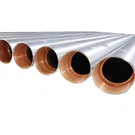


Hey there! I'm a supplier of SAW (Submerged Arc Welded) OCTG (Oil Country Tubular Goods). In the oil and gas industry, SAW OCTG plays a crucial role. These pipes are used in various drilling and production operations, so getting their dimensional accuracy right is super important. Let's dig into what the requirements for the dimensional accuracy of SAW OCTG are.
Wall Thickness
First up, wall thickness is a key factor. The wall thickness of SAW OCTG needs to be within a certain tolerance range. If the wall is too thin, the pipe might not be able to withstand the high pressures and harsh conditions down in the well. On the other hand, if it's too thick, it could add unnecessary weight and cost.
For most standard SAW OCTG, the wall thickness tolerance is usually specified as a percentage of the nominal wall thickness. For example, it could be something like ±12.5% of the nominal value. This tolerance allows for some variation during the manufacturing process while still ensuring that the pipe meets the performance requirements.
Let's say we have a pipe with a nominal wall thickness of 10 mm. With a ±12.5% tolerance, the acceptable wall thickness would range from 8.75 mm to 11.25 mm. During production, we use advanced measuring tools like ultrasonic thickness gauges to check the wall thickness at multiple points along the pipe. This helps us make sure that every part of the pipe is within the specified tolerance.
Outer Diameter (OD)
The outer diameter of SAW OCTG also has strict requirements. The OD needs to be accurate because it affects how the pipe fits into other components in the well system. For instance, if the OD is too large, the pipe might not fit properly into the wellhead or other connecting parts. If it's too small, there could be leaks or instability.
The tolerance for the outer diameter is typically given as a fixed value or a percentage of the nominal OD. For example, it could be ±0.5% of the nominal OD for pipes used in standard applications. So, if we have a pipe with a nominal OD of 200 mm, the acceptable OD would range from 199 mm to 201 mm.
We use precision measuring devices like calipers and laser measurement systems to measure the OD. These tools can provide highly accurate readings, allowing us to make any necessary adjustments during the manufacturing process.
Length
Length is another important dimension. The length of SAW OCTG pipes needs to be accurate to ensure proper installation and connection in the well. Usually, the length tolerance is specified as a fixed value, such as ±50 mm for standard lengths.
During production, we cut the pipes to the required length using cutting machines with high precision. After cutting, we measure the length of each pipe to make sure it meets the specification. This is crucial because if the pipes are too short, they might not reach the desired depth in the well, and if they're too long, it could cause problems during installation.


Straightness
Straightness is often overlooked but is actually very important for SAW OCTG. A pipe that is not straight can cause issues during installation and operation. It might not be able to be properly inserted into the well, or it could put extra stress on the connections.
The straightness requirement is usually specified as a maximum deviation from a straight line over a certain length. For example, the maximum deviation might be 0.2% of the pipe length over a 3 - meter section. To ensure straightness, we use straightening machines during the manufacturing process. After straightening, we use straightness measurement devices to check if the pipe meets the requirement.
Thread Dimensions (for Threaded Pipes)
If the SAW OCTG pipes are threaded, the thread dimensions are extremely important. The threads need to be accurate so that the pipes can be properly connected. The thread pitch, thread depth, and thread angle all have specific tolerance requirements.
For example, the thread pitch tolerance might be ±0.05 mm. This ensures that the threads on different pipes can mate properly. We use thread gauges to measure the thread dimensions and make sure they are within the specified tolerance.
Impact on Performance
Getting the dimensional accuracy right is not just about meeting the specifications; it has a direct impact on the performance of SAW OCTG. Pipes with accurate dimensions are more likely to have a longer service life. They are less prone to leaks, which is crucial in the oil and gas industry where leaks can lead to environmental disasters and financial losses.
Accurate dimensions also improve the overall efficiency of the well system. Pipes that fit properly into the wellhead and other components can reduce the risk of blockages and improve the flow of oil and gas.
Our Quality Control Process
As a SAW OCTG supplier, we have a strict quality control process in place to ensure that all our pipes meet the dimensional accuracy requirements. We start with high - quality raw materials and use advanced manufacturing techniques.
During production, we have multiple inspection points. At each point, we measure the dimensions using the latest measuring tools. If a pipe does not meet the dimensional requirements, we either rework it or reject it. This way, we can guarantee that every pipe that leaves our factory is of the highest quality.
Related Products
If you're in the market for SAW OCTG, you might also be interested in some related products. For example, Pup Joint is a short section of pipe that can be used to connect different lengths of pipes. Casing is another important product that provides structural support to the wellbore. And if you need high - performance connections, Premium Connection is a great option.
Let's Connect
If you're looking for high - quality SAW OCTG that meets all the dimensional accuracy requirements, we'd love to hear from you. Whether you're involved in a small - scale drilling project or a large - scale oil and gas operation, we can provide the right pipes for your needs. Don't hesitate to reach out to us for more information or to start a procurement discussion. We're here to help you get the best SAW OCTG for your project.
References
- API (American Petroleum Institute) Standards for Oil Country Tubular Goods
- ISO (International Organization for Standardization) Standards related to Pipe Manufacturing and Dimensional Accuracy