
A drill collar is an essential tool used in oil and gas rigs for drilling operations. It has many functions, including providing weight on the drilling bit for efficient drilling and stability during operation. Understanding the importance of drill collars and how they work is vital for successful drilling operations. In this article, we will explore the significance of drill collars and their role in the drilling process.
1. Definition of drill collars
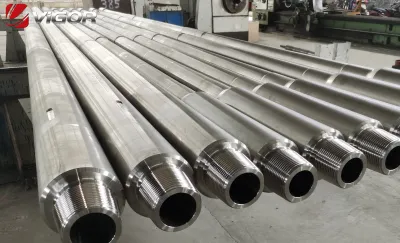
A drill collar is a heavy, thick-walled steel tube with threaded connections cut on both ends that we use in oilfield drilling rigs. They are designed to withstand downhole conditions while under compression and tension. While designing the drilling bottom hole assembly (BHA), drilling engineers place drill collars below the drill pipes or the heavy drill pipes above the Drill Bit as drill collars are the predominant component of the Drilling BHA. To select the proper drill collars, you must have all the information about Drill collar Weights, Size, Specs, Definition, lengths, and types.
2. Manufacturing process
In addition, they are manufactured from chrome-molybdenum alloy 4140 (4140 is a code that indicates the chemical makeup of the metal). Furthermore, they are heat-treated and quenched over their entire length, with a Brinell hardness range of 255 to 341 to obtain mechanical properties as specified by API Spec 7-1. Their bore is accurately machined to ensure smooth, balanced rotation. Collars are manufactured in a wide range of sizes (ODs) and are available in length ranges 2: 9.15 – 9.76 m (30 – 32 ft); and 3: 12.8 – 13.27 m (42 ft-43 ft).
Drill collars can also be manufactured using magnetic steel or spiral collar, including complex threaded connections, weight increases, and spiral grooves on the outside surface for better drilling mud type flow control.
3. Drill collars functions
Some of the functions of the collars are as follows:
Provide weight on bit (WOB) & Increase bit performance.
Minimize bit rotational stability problems from drill string vibrations, wobbling, and jumping.
Provide strength needed to run in compression
Minimize directional control problems by providing stiffness to the BHA to help drill straighter or vertical holes.
Keep the drill string in tension to reduce bending stresses and drill string failures due to fatigue.
4. Drilling collar types
(1) slick type
The slick type is the most common one that has been used since the beginning. It has no features. Its major function is to add weight to the bit and increase the stability while drilling.
(2) spiral drill collar
When drilling through certain formations, the large diameter D/Cs can become stuck (Pipe sticking problem) against the borehole (differential sticking). This is likely to happen when the formation is highly porous, using a large overbalance of mud pressure, and the well deviates. One method of preventing this problem is to reduce the contact area of the collar against the wellbore. We can cut the spiral grooves into the collar surface to reduce its surface area.
We commonly use this type. They have spiral flats, or shallow depressions, that are machined in their surface along the more significant part of their lengths. This reduces their effective weight per unit length by approximately 4%. Reducing the wall contact area between the DC and the hole wall dramatically reduces the possibility of differential wall sticking.
(3) square type
These are drill collars with a square section and a diagonal dimension 1.6 mm (1/16″) less than the drill bit size, with hard-facing material applied to the corners. We generally run this type in the string when drilling crooked hole formations. The reason is to provide maximum stabilization and prevent deviation from the existing course of the hole. The square type use is, however, not commonplace.
(4) non-magnetic type
The most common type of drill collars is the non-magnetic drill collar. It is made from alloy steel with an outer surface machined to a specific smoothness and an elevator recess radius that meets dimensional requirements. We should pay special care when making up NMDCs. This is because the material is more susceptible to the galling of the threads and shoulders than normal drill collars. They aim to isolate directional Survey Instruments from magnetic distortion due to the steel Drill String.
Vigor's drill collars are manufactured in strict accordance with API Spec. 7-1 and NS-1 standards. Vigor produces different types of drill collar, including spiral drill collar and non-magnetic drill collar. Vigor has always adhered to the customer-centric service philosophy. Choosing to work with us is choosing the best partner. If you are interested in us, please do not hesitate to contact us.
For more information, you can write to our mailbox:
info@vigorpetroleum.com (Erica)
mail@vigorpetroleum.com (Joppa)
Information Source:
https://onepetro.org/SPEDRM/proceedings-abstract/63DRM/63DRM/SPE-501-MS/160568
https://onepetro.org/JPT/article-abstract/36/04/637/73183/Drill-Collar-Length-is-a-Major-Factor-in-Vibration?redirectedFrom=fulltext


