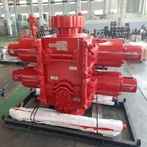
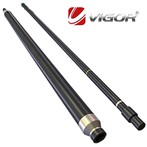
The primary motivation for using non-mag drilling tools is to enable accurate directional surveying. MWD tools typically include a magnetometer (compass) and accelerometers. The magnetometer measures Earth's magnetic field to determine azimuth (direction) of the wellbore. If there's a big piece of magnetic steel nearby (like a drill collar), it will distort the field and introduce error in the measurement. This is known as BHA magnetic interference and can make the azimuth readings unreliable or even unusable.
By incorporating non-mag collars:
The sensitive magnetometers in the MWD tool (or a separate single-shot survey tool) are surrounded by non-magnetic metal for a certain distance, shielding them from the influence of the rest of the steel drill string. Essentially, above and below the MWD tool, you would have non-mag sections. Above, you might have non-mag collars; below (between the tool and the bit) often the drill collars might still be steel, but the distance is usually sufficient that the bit and steel below doesn't interfere significantly.
The length of non-mag section needed is determined by modeling or empirical standards. For example, one guideline suggests that having the compass at least 15-30 feet away from any steel will keep the magnetic azimuth error below a certain threshold (like 0.25°). Often companies have software that calculates the needed length given the expected magnetic properties of the BHA, the latitude (Earth's field strength varies with location), etc.
In practice, what happens is: you might run, say, 2–3 non-mag collars (each maybe 31 ft long) back-to-back. The MWD tool is typically housed in a non-mag collar itself (often the collar is designed to hold the MWD sensors inside). So the MWD tool might be placed in the bottommost non-mag collar. Additional non-mag collars above provide further buffer. Then above that, you transition to regular steel drill collars for weight. This arrangement ensures that when the MWD's magnetometers measure the field, the nearest big steel masses are sufficiently far away that their influence is minor.
Additionally, non-mag subs and other tools may be used: for example, a non-mag stabilizer or a non-mag crossover sub could be included, further extending the magnetically neutral area.
Not only do they ensure accurate surveys, but non-mag collars maintain the required drilling performance. They act just like normal collars to provide weight on bit (WOB) and stiffness to the BHA. This is critical in directional drilling to control well trajectory –you often need a certain amount of weight and stiffness to maintain angle or build/drop as needed. Non-mag collars allow this without sacrificing survey quality.
In summary, non-magnetic drill collars are essential for housing MWD and LWD tools and allowing them to perform correctlypetrogears.com. Without them, the directional driller would not trust the azimuth readings, making it nearly impossible to steer the well accurately. Non-mag BHA components effectively isolate the instruments from magnetic noise.
Beyond just drill collars, "non-magnetic drilling tools" can encompass various BHA components. Let's go through where and how non-magnetic materials are used in the drilling assembly:
Non-Mag Drill Collars in BHA: As discussed, any BHA with an MWD tool will include a series of non-mag drill collars. Even in some cases without an MWD, if using certain magnetic survey tools, a non-mag might be used to reduce interference. They are also used in certain fishing or casing alignment applications where a magnet might be used (so non-mag prevents interference with magnetic fishing tools or casing alignment tools).
Non-Magnetic Subs: There are non-mag crossover subs or pony collars. These are shorter pieces (maybe 1-5 ft) that can connect tools. For example, the MWD tool itself is often contained in a non-mag collar housing which is essentially a sub with the MWD inside. Also, when running a mud motor (which typically has a steel housing that can be magnetized from its power section), often a non-mag flex sub is placed between the motor and the MWD to ensure the motor's magnetism doesn't affect the tool.
Measurement While Drilling (MWD) and Logging While Drilling (LWD): All these tools rely on a non-magnetic environment. The non-mag collars ensure accurate measurements of azimuth, as well as some LWD sensors that might use electromagnetic signals. In LWD, for example, nuclear tools or formation evaluation sensors are less affected by magnetics, but they often are run in the same string as MWD so they benefit from the placement of non-mag above.
Steering Tools (e.g., Magnetic Mud Motors): If a steering tool uses magnetics (some older systems might have magnetostriction sensors or such), non-mag would be essential. In modern rotary steerable systems (RSS), usually the RSS is placed below the MWD, which is in a non-mag. The RSS itself might be largely non-mag as well, depending on its design, to avoid interference.
Wireline Logging in Drill Pipe: Sometimes, wireline tools are pumped through drill pipe for logging (when open-hole logging is required in high-angle wells). Non-mag drill collars can provide a low-interference zone if any logging tools have magnetometers or if one is doing something like oriented coring, etc.
Survey & Collision Avoidance: In complex wells (like multi-well pads or offshore with many wellbores), knowing exact wellbore position is critical to avoid collisions. The high accuracy surveys enabled by non-mag BHA components help in collision avoidance planning (since you reduce the uncertainty in well position by having good surveys). The better the magnetic environment (using non-mag), the smaller the positional uncertainty of the well path.
From a drilling performance perspective, non-mag collars also contribute to directional control. They behave like normal drill collars in terms of stiffening the BHA. This is important: for instance, in a directional BHA, you might have a bent motor with some flexible collars to build angle, and then stiff collars to lock in the angle. Non-mag collars can be part of that design (some companies might choose to place one non-mag collar near the bit even if not strictly needed for MWD, just to have some weight and also reduce magnetic interference for some near-bit measurement devices).
Non-mag tools are also critical in special applications like relief well drilling – you might run additional non-mag in a relief well if using magnetic ranging tools (which deliberately detect magnetic fields from another well). In such scenarios, one might actually temporarily magnetize a section of the target well's casing and use a magnetic sensor in the relief well to find it. The relief well's BHA might include non-mag sections to not obscure the target's signal.
In complex drilling environments where magnetic interference compromises precision, Vigor delivers engineered Non-mag Drilling Tools as your strategic safeguard. We co-create solutions-collars, subs, MWD protectors-using proprietary alloys (μ<1.002) that become invisible to magnetic fields. Forget generic inventory; every tool is partner-driven, calibrated to your well's unique electromagnetic profile and trajectory challenges.
Our engineers don't just supply components-they embed themselves in your operation. By simulating BHA magnetic footprints and formation interactions pre-drill, we position non-mag tools to create zero-distortion zones around critical sensors. This proactive defense prevents costly sidetracks and MWD resets.
Validation transcends compliance:
Leveraging direct access to specialized foundries, Vigor compresses lead times by 40% while reducing total well costs 18–25% through avoided NPT. We transform non-mag procurement from a necessary expense to a precision well placement enabler-ensuring you hit subsurface targets with uncompromised accuracy.
For more information, you can write to our mailbox info@vigorpetroleum.com & marketing@vigordrilling.com