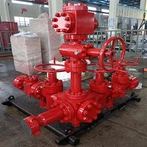
How do geologists "see" oil and gas reservoirs thousands of meters beneath the Earth's surface? Their primary "magic eye" is well logging technology. If drilling is like giving the earth an injection, then logging is like inserting a series of sensors into the "needle hole" to perform a comprehensive "CT scan" of the formation.
However, the raw output-the colorful, undulating curves-is not the final answer. They are just physical response data, much like the black-and-white images from a hospital CT scanner, which are meaningless without a doctor's diagnosis. Translating these curves into intuitive geological language (identifying sandstone, measuring porosity, determining fluid content) requires a critical step: log interpretation. This is a "decoding" process integrating physics, geology, and computer science.
This article systematically walks through the "standard assembly line" of conventional log interpretation, revealing how subsurface information is decoded step by step.
What is "Conventional Logging"?
This refers to the "basic package" of core curve combinations run on almost every well. It is cost-effective and widely applicable, forming the foundation of all interpretation.
- Gamma Ray (GR): Measures natural radioactivity. Shales have high GR; clean sandstones/carbonates have low GR. It's the primary tool for distinguishing shale from potential reservoir rock.
- Spontaneous Potential (SP): Measures electrical potential differences. In permeable sandstones, it shows clear deflection (anomaly), helping identify permeable zones and estimate formation water salinity.
- Resistivity: The core curve. Rock framework is non-conductive; conductivity comes from saline water in pores. Rocks with high-salinity water have very low resistivity; rocks filled with oil/gas (insulators) show very high resistivity. It's the key to distinguishing hydrocarbon zones from water zones.
-
The "Porosity Trio": Three logs combined to calculate porosity (the void space in rock).
1.Sonic Transit Time (AC/DT): Measures sound wave travel time. Slower travel time (higher interval transit time) generally indicates higher porosity.
2.Density (DEN/RHOB): Measures bulk density. Lower density can indicate higher porosity or the presence of light hydrocarbons.
3.Neutron (CNL/NPHI): Measures the "hydrogen index," highly sensitive to fluids (water and oil) in pores, thus indicating porosity.
The Standard Four-Step Interpretation Workflow
A rigorous interpretation process follows interconnected steps like an assembly line. Any oversight can lead to deviations in final conclusions.
Step 1: Data Preparation & Quality Control (QC)
This is the "foundation-laying" stage. If raw data is flawed, subsequent interpretations will be meaningless ("Garbage In, Garbage Out").
- Data Loading & Verification: Ensure all curves are loaded with correct names, units, and depth information.
- Depth Matching: Different tools run in separate passes can have depth mismatches. Aligning all curves to a consistent depth reference is critical.
- Environmental Corrections: Raw measurements are affected by borehole size, mud invasion, temperature, and pressure. Software or charts are used to correct these effects and restore true formation values.
- Quality Check: Remove "spikes" (erroneous data from tool malfunctions) and flag intervals with data distortion due to borehole collapse.
Step 2: Qualitative Interpretation
With corrected curves, the interpreter begins an initial "diagnosis" based on geological principles and pattern recognition.
- Lithology Identification: Use GR/SP to preliminarily separate sandstone zones (low GR, SP anomaly) from shale zones (high GR, flat SP). Cross-plots (e.g., neutron-density) are powerful tools for identifying complex lithologies.
- Reservoir Identification: Look for characteristic signatures like low GR (less shale) combined with porosity indication from the trio and high resistivity (potential hydrocarbon).
- Fluid Identification:
1.High Resistivity is the primary indicator of hydrocarbons.
2.The "Gas Effect": Gas has very low density and hydrogen index. In gas zones, the density log reads too low (apparent high porosity), and the neutron log reads too low (apparent low porosity), creating a classic "crossover" or "separation" pattern – a key gas indicator.
-
Stratigraphic Zonation: Divide the well into consistent "layers" based on curve character changes, preparing for detailed quantitative analysis.
Step 3: Quantitative Calculation
This is the core process, turning qualitative hunches ("this looks like oil") into quantitative numbers ("a 10-meter zone with 15% porosity and 70% oil saturation").
- Calculate Shale Volume (Vsh): Shale in reservoir rock can clog pores and affect resistivity. Using GR (or other methods), the percentage of shale volume is calculated. Accurate Vsh is fundamental for subsequent calculations.
- Calculate Porosity (φ): This determines how much fluid the rock can hold.
1.Methods: Use sonic, density, or neutron logs individually, each with specific formulas (like the Wyllie time-average equation for sonic). The most robust method combines density and neutron data in cross-plots. This "density-neutron cross-plot" can simultaneously solve for porosity and lithology, effectively correcting for shale and gas effects to yield the most reliable total porosity.
2.Effective Porosity (φe): Total porosity minus the volume of water bound to clay. This represents the interconnected pore space where fluids can actually flow and is the key parameter for production.
-
Calculate Water Saturation (Sw): This answers the most important question: how much of the pore space is filled with water versus hydrocarbons?
1.The Core Formula: Archie's Equation – The cornerstone for clean (shale-free) formations. It relates:
Sw^n = (a * Rw) / (Rt * φ^m)
(Where a, m, n are lithology-dependent parameters from core experiments)2.Logic: We have true formation resistivity (Rt) from deep resistivity logs. We have calculated porosity (φ). We estimate formation water resistivity (Rw) from SP or water samples. Plugging these in allows solving for Sw.
3.Hydrocarbon Saturation (Sh): Sh = 1 - Sw.
4.Shaly Sand Correction: In formations with shale, Archie's equation overestimates Sw because shale conducts electricity. More complex models (e.g., Simandoux, Indonesia) are then required.
Step 4: Results Compilation & Comprehensive Evaluation
The final "report" stage.
- Generate Composite Log Plot: All original curves and calculated parameters (Vsh, porosity, Sw, lithology profile) are plotted together. This is the formation's final "diagnostic report."
- Apply "Cutoffs": To define economically viable zones ("pay zones"), minimum standards are applied based on regional experience. For example:
1.Shale Volume (Vsh) < 40%
2.Effective Porosity (φe) > 8%
3.Water Saturation (Sw) < 60%
-
Identify Fluid Contacts: Clearly mark oil zones, gas zones, water zones, and transition zones on the plot.
-
Write Interpretation Conclusions: The final deliverable summarizes the reservoirs encountered, their thickness, quality (porosity), and hydrocarbon content (saturation). This forms the basis for geological modeling, reserve estimation, and development decisions (e.g., where to perforate).
Conventional log interpretation is a rigorous decoding process that transforms raw physical measurements into actionable geological insights. It begins with meticulous QC, focuses targets via qualitative analysis, quantifies properties using physical models and mathematics, and culminates in evaluations that guide drilling and production. This workflow demands not only solid theoretical knowledge but also practical experience to know which curve is most reliable and which model fits best in a given geological context. The log interpreter is truly an artist painting a portrait of the hidden subsurface and a navigator guiding the path of exploration.For more detailed information , please don't hesitate to contact Vigor team for more detailed product information.