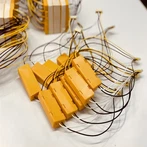
Hard metal, commonly known as "hard band," is known for preserving drill pipe - one of the most precious investments related to directional drilling. Mid-size and maxi-rig horizontal directional drillers frequently struggle with hard band because it causes down-time on the rig due to limited tong space.
Some contributing factors in this article will be explored, as well as ways to mitigate the issues of working around hard metal. Repair, by way of special processes such as building up and reapplying hard metal, will also be explained. One vocabulary disclosure, so as to eliminate any confusion, is the difference between the term drill steel and "drill pipe" and hard metal and "hard band." We'll try and minimize confusion by simply stating either hard metal or drill steel from here out. The problem most contractors face in dealing with the necessary evil of hard metal, is the limit it places on tong space. An average tong die is 5 in. long so the tool joint needs to provide at least 6 in. of drill steel to accommodate a hassle free make and break.
Hard metal, in its most basic form is applied on top of tool joints and next to tong areas. Hard metal is typically run in 1-in. increments or bands; three of them typically on top of box with 1 in. down the 18 degree and 2 in. occasionally on the pin.
Two other popular styles of hard metal include recessed/inlaid flush (picture of turned box side) and tying in with existing hard metal. Inlaying requires about 1/8 in. deep recessed area on the tool joint areas - usually on the box end. It's applied on the box end usually because there's more room and it doubles as a preservative for the pin tool joint when two joints are made up.
Hard metal is commonly rolled in spools and sold off the shelf with several compositions of tungsten or chrome-based wire material. It can be applied in smooth or coarse finish surfaces. Tungsten appears grey and commonly known as "fine particle tungsten," which can rust while most chrome base hard metal is silver in color.
Several types of hard metal boast the term "casing friendly" with names such as Duraband, Tuff band and Armacore. Fine particle tungsten, once upon a time, was the most popular hard metal but began to relinquish its popularity due to how rough the final product turned out. Rough typical tungsten, however; will become smooth over time in abrasive drilling conditions.
How can the operator determine if there's any hard metal when it's not obvious?
Occasionally, a contractor will run into the problem of determining if there's even any hard metal present on the tool joint. This issue comes up most of the time because there's so much dirt and clay still on the raw joint right out of the hole, however; when the pipe's been cleaned and/or sitting out in the weather for months, the rust will camouflage tungsten based hard metal especially when it's inlaid or flush. In order to determine the presence of hard metal, it's wise to brush the determined area and look for varying colors in the material. Lighter tint indicates hard metal while a darker tint indicates drill steel. Going one step further with sulphuric acid might give a better indication but with opposite effects of lighter drill steel and darker hard metal will occur.
The last resort option for identifying hard metal, if there's no acid available, is to try and remove material with a large metal file and compare how the file grips the surface of the softer drill steel while having trouble biting on the hard metal. Oftentimes, thin hard band will allow the vices to actually bite through and grab the drill steel without any issues.
If I want to re-hard metal my string of drill pipe, do I have to be careful about what bands are laid on top of another?
Tungsten hard band can be laid on top or tied in to existing tungsten but not on top of chrome, however; there's a couple of chrome type hard bands, namely Duraband and Armorcore M that can actually be laid over the top of tungsten without cracking. However; the disparity in price may deter some from using chrome type hard metal because it can range from 5 to 10 percent higher cost than plain tungsten.
As the most important part of the whole trenchless process, the quality of the HDD drill pipe determines whether the whole construction is smooth or not. As one of the most professional manufacturers and manufacturers of HDD drill pipes, Vigor team insists on the whole process of product control, through clear production standards, strict requirements for production quality to ensure that customers can receive satisfactory products. If you are also interested in Vigor products, please do not hesitate to get in touch with us, please do not hesitate to get in touch with us to get the most professional products and the best quality technical support.
For more information, you can write to our mailbox info@vigorpetroleum.com & mail@vigorpetroleum.com