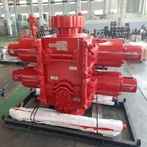
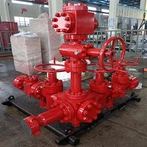
Blowout Preventers are primarily categorized into land and subsea BOPs. They are installed on the wellhead casing head to control wellhead pressure during oil drilling and are the core equipment in well control systems. Relevant testing standards for BOPs include API Specification 16A 'Specification for Drill Through Equipment', GB/T 20174-2019 'Drill Through Equipment for Petroleum and Natural Gas Drilling and Production Equipment', GB/T 17774-2008 'Drilling and Well Servicing Equipment for Petroleum and Natural Gas Industries', and SY/T 6160-2014 'Inspection and Maintenance of Blowout Preventers'.
It is used to close the wellhead during well testing, workover, and completion operations to prevent blowouts. It combines both full closure and partial closure functions, featuring a simple structure, ease of operation, and high-pressure resistance. It is a commonly used safety sealing wellhead device in oilfields for blowout prevention.
Based on sealing principles, BOPs are mainly divided into ram-type and annular. Annular types are further classified into single and double annular BOPs, with one or two annular rubber elements respectively. Ram-type is categorized as single, double, or triple products, with one, two, or three pairs of rams installed to seal different pipe strings and open holes.
Ram-type BOPs primarily consist of a body, side doors, hydraulic cylinders, cylinder covers, pistons, piston rods, locking shafts, sealing components, and rams. They operate by using hydraulic pressure to drive the piston, which moves the rams to close or open, thereby sealing or opening the wellhead. Ram-type feature four types of rams: blind rams, pipe rams, variable bore rams, and shear rams, each serving different well control scenarios. Pipe rams can seal around drill pipes and tubing, and can also support the drill string when necessary. Blind rams can fully seal an open wellbore. In special circumstances, shear rams can cut through drill pipe. Additionally, the side outlet flanges on the body allow for mud circulation and choke-and-kill operations.
Annular BOPs are classified into conical and spherical types based on the shape of their sealing elements. They mainly consist of a body, top cap, rubber element, and piston. it can seal around various sizes of drill pipe, tubing, or casing, and can fully close an open wellbore. During drilling, coring, and logging operations, they can seal around kelly, coring tools, wireline, and slickline. When used with a pressure reducing valve, they allow for stripping operations. The operating principle of an annular BOP involves hydraulic pressure entering the lower chamber (closing chamber) to rapidly move the piston upward. The rubber element, constrained by the top cap, is forced to compress inward by the piston's conical surface, enveloping the drill string and sealing the annular space. When no drill string is present, the rubber element compresses inward until the central void is completely filled with rubber, thus fully sealing the wellbore. its drawbacks include limited usage cycles and unsuitability for long-term well shut-in.
Vigor will provide you with a reliable solution, Please contact us at info@vigorpetroleum.com.