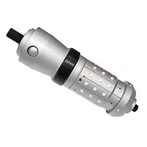
Cement evaluation is most useful when it answers a practical completion question: does the barrier behind casing provide the isolation required for the next operation? A Memory Cement Bond Tool (MCBT) helps answer that question by recording acoustic measurements that indicate cement bonding quality between casing and formation. Because the tool stores data downhole, it can be deployed in situations where conventional real-time transmission is constrained by conveyance method, well trajectory, or operational logistics. The result is a detailed evidence set for remedial cementing, completion acceptance, integrity evaluation, and intervention planning.
Move Beyond a Single Circumferential Measurement
The China Vigor MCBT divides the casing circumference into 8 angular segments, with each segment covering 45 degrees. This produces a 360-degree view of cement-bond condition rather than treating the annulus as one uniform ring. The tool measures cement bond amplitude, or CBL, through near receivers at 2 feet and 3 feet. A far receiver at 5 feet provides variable density log, or VDL, information.
This arrangement helps distinguish a broadly bonded interval from one where bonding quality changes around the casing circumference. Such variation can matter in deviated wells, channels, eccentric annuli, or complex placement history. Interpretation should not depend on one curve alone. Review 8-segment data, CBL response, VDL response, and depth information with the casing, cement, fluid, and completion history.
Integrated Sensors Strengthen Depth and Context
The MCBT integrates gamma ray, a Casing Collar Locator, and temperature sensors. Gamma-ray information assists formation correlation, the CCL supports casing-joint depth matching, and temperature can reveal wellbore changes that are relevant to interpretation. The tool also records inclination and relative azimuth, which helps establish orientation in deviated or horizontal sections.
A 13-core quick-change sub supports connection with other logging tools when a broader data suite is needed. The modular sensor architecture can simplify maintenance because components can be serviced separately. These measurements do not remove the need for calibrated interpretation, but they help align acoustic data with the well interval and tool orientation.
Published Limits Define the Deployment Envelope
The MCBT is available with pressure ratings of 14,500 psi, or 100 MPa, and 20,000 psi, or 140 MPa. The stated temperature rating is 350 degrees Fahrenheit, or 175 degrees Celsius. It is designed for casing outside diameters from 4 inches, or 101 mm, to 10 inches, or 254 mm. The tool outside diameter is 2-3/4 inches, or 70 mm, and its listed weight is 97 lb, or 44 kg.
The maximum logging speed is 32 ft/min, or 10 m/min, and the tool should be positioned at the center of casing for the stated logging condition. The power system operates from 15 to 30 VDC, with listed current of 80 mA at 20 VDC. The ultrasonic transducer is specified at 20 KHz. Before deployment, verify centralization, fluid environment, conveyance limits, pressure-temperature exposure, and tool-string compatibility with planned restrictions.
Memory Architecture Supports Complex Well Access
Memory logging is valuable where conventional wireline access is limited. The MCBT may be conveyed by drill pipe, tubing, slickline, or wireline for high-angle and horizontal wells. Its memory capacity is 10G bits, with a 320 ms sampling period and logging duration of more than 200 hours. After retrieval, data can be read at more than 10 Mb/s, supporting prompt interpretation.
A practical execution plan should preserve data quality from run preparation through post-job analysis:
Correlate the planned interval with casing-joint information and confirm centralization so the acoustic response can be evaluated against a reliable depth reference.
Review 2-foot and 3-foot CBL data, 5-foot VDL data, 8-segment coverage, temperature, and orientation together before deciding whether a remedial treatment is necessary.
Post-logging calibration allows adjustment based on actual downhole conditions. This matters when temperature, fluid properties, or tool position influence raw acoustic response. The objective is an informed isolation decision supported by traceable measurements.
Cement Evaluation Should Lead to an Actionable Decision
A memory cement bond survey is valuable when it connects measurement to a clearly defined operational choice: accept the cement, target a remedial interval, change a completion plan, or gather more evidence. By combining 8-segment circumferential coverage, 2-foot and 3-foot near-receiver CBL measurements, 5-foot VDL response, integrated sensors, and memory deployment flexibility, the MCBT provides a structured basis for that decision.
About China Vigor
China Vigor supplies logging, completion, drilling, and production tools for oil and gas operations. For Memory Cement Bond Tool (MCBT) selection, technical support, or product information, contact China Vigor at info@vigorpetroleum.com or Tel: 0086 029 81161513.
Disclaimer: Cement-bond interpretation must be performed with verified well data, calibrated procedures, and the approved integrity-evaluation program.