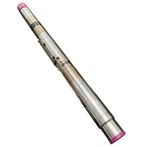
Cement bond logging answers a question that decides the well's future: is the cement actually bonded to the casing and the formation, or is there a channel behind pipe. In a vertical well the tool goes in on wireline and the answer comes back the same day. In a horizontal well wireline cannot get to the toe, so the tool has to record the data downhole and give it back when it is retrieved, which is what a memory cement bond tool is for. The trade is that the answer arrives after the trip rather than during it, so the job has to be planned around a single good pass.
Why a Cement Bond Tool Goes on Pipe
The tool can be run on drill pipe, tubing, slickline or wireline, and the choice follows the trajectory. In a long lateral the pipe carries the tool to depth and the memory system records while the string is moved in a controlled pass. That conveyance decision is made before the job, because the tool string length, the centralisation and the logging speed all depend on whether the pipe is rotating or sliding. On a pipe-conveyed job the tool is usually run below a spacer and above a centraliser, and the string is moved at a speed the logging engineer sets rather than the driller.
Eight Segments and Three Receiver Spacings
The measurement is built around eight angular segments of 45 degrees each, giving a 360 degree picture of the bond rather than an average around the circumference. Near receivers at 2 feet and 3 feet provide the cement bond amplitude, and a far receiver at 5 feet provides the variable density log. That combination separates a good bond from a channel that happens to sit on the low side, which a single averaged amplitude would hide. The 45 degree segments also let the interpretation separate a channel on the low side from a general poor bond around the circumference.
Memory Capacity and Logging Speed
The tool stores 10G bits, which supports more than 200 hours of continuous recording, and samples at 320 ms. Maximum logging speed is 32 feet per minute (10 meters per minute), and the pressure rating is 14,500 psi (100 MPa) or 20,000 psi (140 MPa) depending on the configuration. Temperature rating is 350 degrees F (175 degrees C), and the tool runs on 15 to 30 volts DC at 80 mA, which is within the supply of most memory logging strings. The 10G bits of memory is what makes a 200 hour run possible without pulling the tool to dump data.
Cement Bond Tool Data After the Run
The data is read at over 10 Mb/s once the tool is at surface, and the calibration can be adjusted after the fact against the actual downhole conditions. That post-logging calibration is what makes a memory run comparable with a wireline run: the tool records the raw waveform, and the processing applies the correction when the temperature and the fluid are known rather than assuming them at the wellsite. In a horizontal well the tool also records inclination and relative azimuth, which is how the segments are tied back to the high side of the hole.
Record the tool orientation and the CCL depth on every pass.
Hold the logging speed at or below 32 feet per minute.
Keep one repeat section for correlation before pulling out.
Tool String and Centralisation Checks
The tool is 2-3/4 inches (70 mm) outside diameter and weighs 97 lbs (44 kg), so it will pass casing from 4 inches to 10 inches. Centralisation is the detail that decides data quality: a tool that is not centred measures a bond that varies with position rather than with cement. Check the centraliser size against the casing, confirm the 13-core connection is continuous through the string, and verify the gamma ray and CCL channels before the tool goes in. A tool that is off centre by a few millimetres produces a bond map that looks like a channel, and the operator then spends a week chasing a cement job that was fine.
A cement bond tool does not fix a bad cement job, but it tells the truth about one. Run it centred, at the right speed, with a record that can be calibrated, and the answer holds up when the well is put on production.
For more information, please contact China Vigor at info@vigorpetroleum.com or call +0086 29 81161513.