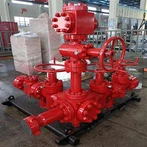
Deepwater well construction presents a fundamental contradiction: operators need to isolate the reservoir during upper completion installation, yet traditional mechanical intervention to open or close isolation valves demands wireline runs, coiled tubing trips, or even rig mobilization - each adding days of costly rig time and exposing the well to additional risk. In water depths exceeding 2,000 meters and well pressures above 15,000 psi, the margin for error shrinks to near zero, making reliable, interventionless downhole barrier technology not just an operational preference but a safety imperative.
The Technology Behind Remote-Open Downhole Barrier Valves
A remote-open bi-directional downhole barrier valve combines a ball-type or flapper-type closure mechanism with a hydraulic or electro-hydraulic actuation system that can be triggered from the surface without physical intervention. China Vigor's Remote-open Bi-directional Downhole Barrier Valve features two independent opening modes - hydraulic remote one-time opening and mechanical switch opening - that can operate independently or in combination. This redundancy is critical: if the primary hydraulic system cannot be activated due to control-line damage, the mechanical backup ensures the ball valve can still be shifted open using standard wireline shifting tools. The valve's ball sealing mechanism, constructed from PEEK high-temperature sealing materials, provides bi-directional isolation rated to full working pressure of 15,000 psi and operating temperatures exceeding 175°C (347°F).
- The subsurface safety valves market is projected to grow from $4.77 billion in 2025 to $7.59 billion by 2035 at a CAGR of 6.1%, driven by deepwater exploration and tightening regulatory standards.
- China's new national standard GB/T 46582-2025, published specifically for petroleum and natural gas well formation isolation valves, mandates rigorous bidirectional pressure testing and V0 gas-tight validation.
Field Performance: Saving Rig Time and Reducing Risk
Case histories from deepwater basins confirm the transformative impact of remote-open barrier valves. In an Angola deepwater development, an operator deploying a remote-open bi-directional downhole barrier valve was able to open the valve without any wireline or coiled tubing intervention, saving an estimated 3 days of rig time per well. At a deepwater rig day rate of approximately $500,000, this represented a direct cost saving of $1.5 million per completion. In the Gulf of Mexico, a similar valve deployment eliminated the need for a separate subsea tree intervention trip, reducing total completion time by 8–12% per well and enabling the operator to batch-complete three additional wells within the same drilling campaign.
- China Vigor's e remote barrier valve saved 29 hours of rig time in the UK North Sea by enabling packer-setting without intervention.
- China Vigor's ball valve demonstrated debris tolerance in deepwater Brazil, operating reliably despite 10 meters of accumulated debris above the ball.
Bi-Directional Isolation Capabilities and Regulatory Compliance
The defining technical feature of a bi-directional downhole barrier valve is its ability to seal against pressure from both above and below. During upper completion installation, the valve holds pressure from the reservoir below while the completion string is run; after installation, it holds pressure from above during subsea tree commissioning. This dual-direction sealing capability is validated through API 19V V1 qualification - the highest rating for barrier valves - and must pass gas-tight tests under the V0 validation level. The China Vigor design incorporates a bottom boost piston that increases sealing force as differential pressure rises, ensuring bubble-tight closure even at low differential pressures where simple flapper valves might leak.
- The modular design allows the remote-open and mechanical-open modules to be selected independently, adapting the valve to specific well conditions without redesigning the entire completion string.
- The large-bore internal diameter enables service string passage through the valve interior, preserving the option for future through-tubing interventions.
Applications Beyond Deepwater: Multi-Zone and HPHT Completions
While remote-open barrier valves gained prominence in deepwater completions offshore West Africa, Brazil, and the Gulf of Mexico, their application scope has expanded significantly. For multi-zone intelligent completions, these valves enable selective zone isolation for production optimization, reservoir management, and workover operations without killing the well. In HPHT wells in the Middle East, where static bottom-hole temperatures exceed 350°F and pressures approach 20,000 psi, the valve's PEEK sealing technology and high-strength alloy construction have demonstrated over 500 open-close cycles without performance degradation.
As a lubricator valve, the bi-directional barrier valve provides pressure integrity for wireline and coiled tubing operations through the completion string, protecting the subsurface safety valve from dropped objects.
For well suspension applications, two remotely operated barrier valves can be deployed as a redundant deep-set barrier system, enabling batch drilling and completion operations with greater efficiency.
As the oil and gas industry pushes into deeper waters and more extreme reservoir conditions, the remote-open bi-directional downhole barrier valve has evolved from a niche technology into a standard component of deepwater well barrier philosophy. The combination of interventionless operation, dual-direction sealing, and redundant actuation modes delivers a measurable safety and economic advantage that is increasingly recognized by regulators, operators, and service companies worldwide.
For more information, please contact China Vigor at info@vigorpetroleum.com or call +0086 29 81161513.