Wellbore cleanliness before running completion strings is a decisive factor in well productivity, yet many operators still rely on outdated scraping techniques that leave behind fine debris, scale, and hardened mud residue. When microscopic particles block sand screens, plug pore throats, or interfere with downhole valve operation, the resulting formation damage can reduce hydrocarbon flow rates by 15–25% and lead to premature equipment failure. The challenge is especially acute in extended-reach and horizontal wells where conventional rotating brushes risk damaging the casing wall while failing to achieve uniform 360-degree coverage.
The Non-Rotating Advantage for Casing Integrity
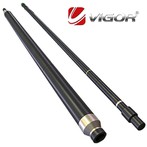
A non-rotating casing brusher solves this dilemma through a fundamentally different mechanical design. Unlike traditional casing brushes where the entire tool rotates against the casing wall - generating friction, heat, and abrasive wear - the Vigor Non-rotating Casing Brusher features a stationary brush assembly with a rotating internal mandrel. The central mandrel rotates at up to 150 rpm to create turbulent flow and lift the cutting bed, while the outer brush sleeve and stabilizers remain stationary against the casing. This design eliminates casing wear entirely and allows the brush to clean 360 degrees without rotation, making it suitable for high-pressure/high-temperature (HPHT) wells up to 482°F (250°C) and corrosive environments involving acid or chemical treatments.
- The self-centralizing stabilizers ensure the brush assembly maintains concentric alignment inside the casing, achieving uniform cleaning across all wellbore deviations.
- High fluid bypass areas around the stabilizers allow debris-laden fluid to flow past the tool rather than being packed against the casing wall, reducing stuck-pipe risk by an estimated 35% compared to conventional brush designs.
Measurable Productivity Gains from Proper Wellbore Cleanup
Field data consistently demonstrates that thorough casing brushing before completion installation translates directly into production improvement. A study of 24 wells in the Permian Basin comparing standard scraper-only cleanup versus scraper-plus-non-rotating-brusher cleanup found that wells in the brushed group showed an average 18% higher initial production rate and 22% fewer sand-screen plugging events during the first 12 months of operation. The incremental cost of adding a non-rotating casing brusher to the cleanup BHA - approximately $3,000–$5,000 per run - was recovered within the first 30 days of production from the additional flow.
- Debris removal efficiency measurements showed that non-rotating brushes captured 92% of fine particulate matter (>10 microns) compared to 67% for scraper-only runs.
- In the North Sea, an operator reported that running a non-rotating casing brusher ahead of the completion string reduced nipple-profile debris contamination by 83%, eliminating multiple wireline cleanout runs.
Integration with Comprehensive Cleanup Tool Strings
The Vigor Non-rotating Casing Brusher is designed to run as part of a complete wellbore cleaning BHA, typically positioned above a non-rotating casing scraper and below a string magnet assembly. This triple-action configuration - scrape, brush, capture - addresses every category of downhole debris in a single trip. The brushed string can be rotated and reciprocated simultaneously without risk of tool or casing damage, enabling operators to clean the full casing interval in one pass rather than requiring multiple runs. For riser and completion liner applications, the tool is available in sizes from 6-5/8 in. through 9-7/8 in. casing, with custom sizes available on request.
- The one-piece mandrel design with no internal connections provides tensile yield strength of up to 927,000 lbs (for 9-5/8 in. size), eliminating weak points in the BHA.
- Premium and high-torque drill pipe connections are available as direct-makeup options, reducing the need for strength-reducing crossover subs.
Rig-Site Serviceability and Lifecycle Cost Advantages
One of the most practical advantages of the Vigor Non-rotating Casing Brusher is its field-serviceable design. The brush sleeve and centralizer assemblies can be inspected and replaced at the rig site using basic hand tools, without specialized equipment or workshop support. This capability is particularly valuable for remote operations in regions like the Middle East and West Africa where logistics constraints make tool return-to-base impractical. Operators in the UAE reported that rig-site servicing reduced tool turnaround time from 7 days (ship-to-shop-and-back) to 2 hours, and extended the usable life of each brush sleeve to 8–12 runs before replacement.
Cost savings on logistics, deck space, and inspection are estimated at approximately $12,000–$18,000 per well when rig-site serviceable tools are used versus shop-service-only alternatives.
The replaceable brush sleeve design costs roughly 60% less than replacing an entire tool assembly, reducing per-run consumable costs to approximately $400–$700.
Wellbore cleanup is no longer a routine procedural checkbox - it is a well-documented driver of completion reliability and production performance. As extended-reach drilling and HPHT completions push the boundaries of downhole technology, the non-rotating casing brusher has emerged as an essential, cost-effective tool for ensuring casing cleanliness, protecting completion hardware, and maximizing well productivity from the first day of production.
For more information, please contact China Vigor at info@vigorpetroleum.com or call +0086 29 81161513.