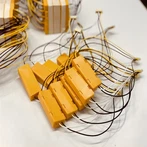
Rod-tubing friction remains the single largest contributor to workover frequency in sucker-rod-pumped wells, accounting for 35–45% of all artificial lift failures in deviated wells. As operators drill longer laterals and produce higher-water-cut fluids, the demands on the rod string have intensified. The sucker rod guide - a precision-molded centralizer installed directly onto the rod body - has evolved from a simple nylon sleeve into an engineered component that withstands abrasive contact, corrosive well fluids, and elevated temperatures. When properly selected and positioned, these guides reduce tubing wear by 70% and double the run life of a rod string in highly deviated wellbores.
The USD 1.8 Billion Sucker Rod Market Drives Accessory Reliability
The global sucker rod artificial lift market, valued at approximately USD 1.8 billion in 2026, is projected to reach USD 2.7 billion by 2035, growing at a CAGR of 5.1% (Grand View Research). This growth is fueled by the expansion of unconventional drilling in the Permian Basin, the Bakken, and Argentina's Vaca Muerta shale, where average well lateral lengths now exceed 3,000 meters. With dogleg severity (DLS) routinely reaching 8–12 degrees per 30 meters in these horizontal sections, rod-string buckling and lateral vibration cause accelerated metal-to-metal wear between the rod body and tubing wall. Sucker rod guides - also called rod centralizers - have become the primary defense against this wear, with operators now installing an average of 15–20 guides per rod string in horizontal wells compared to 3–5 in vertical wells.
The sucker rod market growth from USD 1.8B (2026) to USD 2.7B (2035) at 5.1% CAGR reflects rising demand for reliable rod lift in extended-reach wells.
Average guide density in horizontal wells has risen 4x over the past decade - from 4 guides per string to 18–20 guides per 1,500-meter string.
Material Innovations: Beyond Conventional Nylon to High-Performance Polymers
Modern sucker rod guides are manufactured from advanced engineering polymers selected for specific downhole conditions. Polyamide 66 (PA66) - the industry standard - provides good wear resistance up to 150°C but degrades rapidly in sour (H₂S) environments. Polyphenylene sulfide (PPS) extends temperature capability to 220°C with superior chemical resistance, while polyphthalamide (PPA) offers the best combination of wear resistance and dimensional stability in high-load applications. In comparative ASTM G65 abrasion testing, PPA-based rod guides showed 45% less volume loss than PA66 after 6,000 revolutions at 130 N contact load. For steam-injection and thermal EOR wells where temperatures exceed 250°C, metallic-sleeve centralizers with hardened tool-steel bearing surfaces now deliver service lives exceeding 5 years.
PPA rod guides demonstrate 45% better abrasion resistance than standard PA66 nylon in ASTM G65 testing at 130 N contact load.
PPS centralizers maintain tensile retention above 85% after 1,000 hours of continuous exposure at 200°C in 5% H₂S brine solution.
Guide Geometry and Placement Optimization for Deviated Wells
The evolution from simple fixed-blade guides to advanced rolling-wheel and rotating-sleeve designs has transformed rod-string dynamics. Rolling-wheel rod guides - which incorporate a freely rotating nylon or PPS sleeve that rolls rather than slides against the tubing wall - have been shown to reduce running torque by up to 35% in deviated wells with DLS above 8°/30m. Field studies from the Bakken Formation indicate that wells equipped with a rolling-wheel guide at every third rod coupling experienced 62% fewer tubing leaks over a 36-month period compared to wells using fixed-blade guides on the same spacing. The placement interval is equally critical: CFD-guided modeling now recommends guide spacing of 1.2–1.8 meters in high-DLS intervals and 2.5–4.0 meters in low-curvature sections, reducing total guide count by 22–28% while maintaining equivalent protection.
Rolling-wheel rod guides reduce running torque by 35% in wells with DLS above 8°/30m compared to fixed-blade designs.
Optimized variable-spacing guide placement reduces total guide count by 22–28% while maintaining equivalent tubing wear protection.
Energy Savings and Life-Cycle Cost Reduction
Beyond wear protection, properly designed rod guides contribute directly to energy efficiency. A 2025 study of 120 rod-pumped wells in the Permian Basin found that wells equipped with optimized rolling-wheel guide strings consumed 12–18% less electrical power per barrel of fluid lifted compared to unguided strings. At an average electricity cost of USD 0.07 per kWh and a typical pumping unit load of 25 kW, this translates to annual savings of USD 1,800–2,700 per well - enough to recover guide installation cost within 8–12 months.
Conclusion
Sucker rod guides have evolved from simple friction reducers into engineered reliability components that directly impact artificial lift uptime, energy consumption, and workover frequency. For operators managing hundreds of rod-pumped wells, the return on investment in a comprehensive guide program extends far beyond the initial installation cost.
*For more information, please contact China Vigor at info@vigorpetroleum.com or call +0086 29 81161513.*