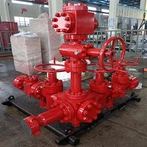
In oil wells with high gas cut, the oil liquid has poor fullness. So if we adopt conventional sucker rod pumps for oil recovery, normally we will get a very low pump efficiency. Meanwhile, gas locking may happen frequently, which will bring a lot of trouble to oil recovery and make us lose countless time and money for repairing the pumps.
What is more serious? Operation with conventional pumps in high gas cut wells will result in "liquid impact", which would accelerate the damage of tubing, sucker rod strings, pump valves, valve cages, and other downhole equipment.
Gas locking: After frequent compression and expansion of the gas in sucker rod pump, the suction valve often cannot be opened normally, So that the crude oil cannot be pumped out. This phenomenon is called "gas locking".
Liquid impact: During the upstroke, if the pump is not completely filled with well liquid, a low-pressure air cap will be formed on the top of the pump chamber between the floating valve cage and the fixed valve cage. During the subsequent downstroke, the gloating valve cage will keep closed until being hit by the well liquid surface. This phenomenon is called "liquid impact" and it will cause severe impact load on the entire artificial lifting system.