


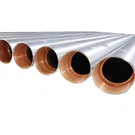


As a trusted supplier of 7" casing, I often encounter inquiries from clients regarding the suitability of our product for high - temperature environments. This is a crucial question, as the performance of casing in extreme conditions can significantly impact the success and safety of various industrial operations. In this blog, I will delve into the technical aspects of 7" casing and explore whether it can be effectively used in high - temperature settings.
Understanding 7" Casing
Before we discuss high - temperature performance, let's briefly understand what 7" casing is. Casing refers to the large - diameter pipe that is installed in a wellbore to protect it and provide structural integrity. The "7"" represents the nominal outer diameter of the casing, which is a standard size commonly used in the oil and gas industry, as well as in other applications such as geothermal energy extraction. You can find more information about Casing on our website.
Casing is typically made from steel, and its properties are carefully engineered to withstand different types of stresses, including pressure, tension, and corrosion. The choice of steel grade, manufacturing process, and additional treatments all play a role in determining the casing's performance in various environments.
High - Temperature Environments: Challenges and Requirements
High - temperature environments pose several challenges to casing materials. As the temperature rises, the mechanical properties of steel can change significantly. For example, the strength and ductility of steel may decrease, which can lead to deformation, cracking, or even failure of the casing. Additionally, high temperatures can accelerate corrosion processes, reducing the casing's lifespan and potentially compromising its integrity.
In high - temperature applications, the casing needs to meet certain requirements. It should maintain its mechanical strength and dimensional stability to withstand the internal and external pressures. It also needs to have good corrosion resistance to prevent degradation over time. Moreover, the casing should be able to resist thermal expansion and contraction without causing excessive stress on the wellbore or other components.
Factors Affecting 7" Casing's Performance in High - Temperature Environments
Steel Grade
The choice of steel grade is one of the most important factors in determining the casing's performance in high - temperature environments. Different steel grades have different chemical compositions and microstructures, which affect their mechanical and thermal properties. For high - temperature applications, steels with high chromium and nickel content are often preferred. These elements can improve the steel's strength, corrosion resistance, and high - temperature stability.
For example, some high - alloy steels can maintain their strength at temperatures up to 500°C or even higher. These steels are designed to resist oxidation and other forms of corrosion, making them suitable for use in harsh high - temperature environments.
Heat Treatment
Heat treatment is another crucial factor. Proper heat treatment can refine the microstructure of the steel, improving its mechanical properties. Processes such as quenching and tempering can increase the strength and toughness of the casing, making it more resistant to high - temperature stresses.
Coating and Protection
Applying a suitable coating to the casing can provide an additional layer of protection against high - temperature corrosion. There are various types of coatings available, such as ceramic coatings and metallic coatings. These coatings can act as a barrier between the steel and the corrosive environment, reducing the rate of corrosion and extending the casing's lifespan.
Case Studies: 7" Casing in High - Temperature Applications
In the oil and gas industry, there are numerous examples of 7" casing being used in high - temperature wells. For instance, in some geothermal wells, where the temperature can reach several hundred degrees Celsius, 7" casing made from high - alloy steels has been successfully employed. These casings are designed to withstand the high - temperature and high - pressure conditions while maintaining their integrity over long periods.
In one case, a well in a geothermal field was drilled to a depth where the temperature was around 350°C. The 7" casing installed in this well was made from a specially designed high - alloy steel and was coated with a ceramic - based coating. After several years of operation, the casing showed only minimal signs of corrosion and maintained its mechanical strength, demonstrating its suitability for high - temperature applications.
Accessories and Their Role in High - Temperature Environments
When using 7" casing in high - temperature environments, the accessories also play an important role. Pup Joint and D10 Coupling are two common accessories that need to be compatible with the high - temperature performance of the casing.
Pup joints are short sections of casing that are used to adjust the length of the casing string. They need to have the same high - temperature resistance as the main casing to ensure the overall integrity of the wellbore. Similarly, D10 couplings are used to connect different sections of casing. They should be able to withstand the high - temperature stresses without loosening or failing.
Conclusion: Can 7" Casing Be Used in High - Temperature Environments?
In conclusion, 7" casing can indeed be used in high - temperature environments, provided that the right steel grade, heat treatment, and protection measures are employed. With proper design and engineering, 7" casing can maintain its mechanical strength, dimensional stability, and corrosion resistance even under extreme temperature conditions.
Our company, as a leading 7" casing supplier, has extensive experience in providing high - quality casing solutions for high - temperature applications. We offer a wide range of steel grades and coating options to meet the specific requirements of our clients. If you are considering using 7" casing in a high - temperature environment, we can provide you with the technical expertise and support you need.
If you are interested in learning more about our 7" casing products or have any questions regarding their use in high - temperature environments, please feel free to contact us for a detailed discussion and procurement negotiation. We look forward to working with you to find the best casing solution for your project.


References
- ASME Boiler and Pressure Vessel Code, Section VIII - Rules for Construction of Pressure Vessels.
- API Specification 5CT - Specification for Casing and Tubing.
- "High - Temperature Materials for Energy Applications" by John W. Jones and others.
- Research papers on high - temperature corrosion and mechanical properties of steel in academic journals.