


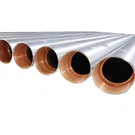


Hey there, folks! I'm a supplier of CRA (Corrosion-Resistant Alloy) pipes, and today I wanna talk about the acoustic properties of these awesome pipes. These CRA pipes are no strangers in industries like oil and gas, chemical processing, and marine applications. They're beloved for their top - notch corrosion resistance, but their acoustic properties are equally fascinating.
First off, sound transmission in CRA pipes is a key aspect. When sound travels through a material, a lot of factors come into play. In the case of CRA pipes, the composition of the alloy has a big say in how sound waves move. CRA pipes are made up of different metals, and depending on the proportion of elements like chromium, nickel, and molybdenum, the density of the pipe changes.
You see, sound waves travel better through denser materials. CRA pipes, with their unique alloy makeup, often have a relatively high density compared to regular carbon - steel pipes. That means sound can propagate more efficiently through them. Let's say there's a noise source inside the pipe, like fluid flowing under high pressure. The sound waves generated will travel along the pipe walls, and because of the CRA pipe's density, they'll keep their energy better over longer distances.


But it's not all smooth sailing for sound transmission. The internal and external conditions of the pipe can also impact it. If there's corrosion or damage on the inner wall of the pipe, it can scatter the sound waves. Scattering makes the sound lose energy faster, and the sound that reaches the other end of the pipe will be weaker and distorted. That's why proper maintenance of CRA pipes is crucial, not just for their structural integrity but also for the quality of sound transmission.
Another important acoustic property is acoustic impedance. Acoustic impedance is like a measure of how much a material resists the flow of sound. It depends on the density and the speed of sound in the material. For CRA pipes, their acoustic impedance is different from other types of pipes. This difference is significant when CRA pipes are connected to other components in a system.
Let's take Coupling as an example. When a CRA pipe is joined with a coupling, there's a transition in acoustic impedance at the connection point. A large difference in acoustic impedance can lead to reflection of sound waves. Some of the sound energy that's supposed to travel through the pipe - coupling system will bounce back. This can be a problem, especially in applications where accurate sound measurement or transmission is required, like in some monitoring systems. Engineers have to take this into account and design the connection carefully to minimize these reflections.
The shape of the pipe also plays a role in its acoustic properties. For instance, Slotted Casing has a different acoustic behavior compared to a regular, solid - walled CRA pipe. The slots in the slotted casing allow some sound waves to leak out, and they also change the way the sound waves travel inside the pipe. The slots can act as small resonators, which can cause certain frequencies of sound to be amplified or attenuated.
Now, think about Casing in general. CRA casing is often used to protect wellbores in the oil and gas industry. The acoustic properties of the casing are important for things like well integrity monitoring. By sending sound waves down the casing and analyzing the waves that come back, engineers can detect any potential issues such as cracks or corrosion. If the acoustic properties of the CRA casing are well - understood, it makes it much easier to interpret these signals accurately.
The frequency response of CRA pipes is yet another aspect worth discussing. Different frequencies of sound interact with the pipe in different ways. Low - frequency sound waves tend to penetrate the pipe more easily and can travel longer distances without significant attenuation. High - frequency sound waves, on the other hand, are more sensitive to the surface conditions of the pipe. They can be absorbed or scattered by small imperfections on the pipe's surface.
In some applications, like in subsea pipelines, the acoustic properties of CRA pipes can be affected by the external environment. The surrounding water, for example, has its own acoustic characteristics. Sound waves can transfer between the pipe and the water, and this interaction can change the way the sound behaves inside the pipe. The pressure and temperature of the water also have an impact. Higher water pressure can compress the pipe slightly, which in turn can change its density and acoustic properties.
So, why should you care about all these acoustic properties when you're considering buying CRA pipes? Well, understanding the acoustic properties helps in many ways. In industries where monitoring and communication using sound is important, such as in oil and gas production, you need pipes that can transmit sound effectively. If the pipes can't handle sound properly, it can lead to inaccurate data collection and reduced operational efficiency.
Let's say you're running an oil well. You use sound - based sensors inside the well to monitor the flow rate and pressure of the oil. If the CRA pipes in the well have poor acoustic properties, the signals from the sensors may be weak or distorted, leading to wrong readings. This can cause problems in production and even lead to safety issues.
When you're looking for CRA pipes, it's crucial to choose a supplier who knows not just about the corrosion resistance but also about the acoustic properties. As a CRA pipe supplier, I've made it my mission to ensure that the pipes I offer have optimal acoustic performance. I work with top - notch manufacturers who follow strict quality control measures to produce pipes with consistent and reliable acoustic properties.
If you're in the market for CRA pipes and need them for applications where acoustic performance matters, don't hesitate to reach out. Whether you need Coupling, Slotted Casing, or Casing, I can provide you with solutions that meet your specific requirements. I can guide you through the selection process, taking into account the acoustic properties and how they'll fit into your system.
Contact me to start a discussion about your CRA pipe needs. Let's work together to find the best pipes for your project!
References:
- Basic Physics of Acoustics textbooks
- Industry research papers on CRA pipe applications
- Technical reports from oil and gas companies on well monitoring using acoustic methods