


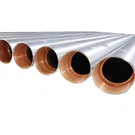


As a SAW (Submerged Arc Welding) OCTG (Oil Country Tubular Goods) supplier, I've witnessed firsthand the critical role that welding quality plays in the performance and reliability of these essential products. SAW OCTG is widely used in the oil and gas industry for various applications, including drilling, production, and transportation. The quality of the welding directly impacts the integrity of the tubular goods, ensuring they can withstand the harsh conditions and high pressures encountered in these environments. In this blog post, I'll explore the key factors that affect the quality of SAW OCTG welding and discuss how we, as a supplier, address these challenges to deliver high-quality products to our customers.
1. Welding Parameters
The welding parameters are the foundation of a successful SAW process. These parameters include welding current, voltage, travel speed, and wire feed rate. Each of these factors must be carefully controlled to ensure proper fusion, penetration, and bead shape.
- Welding Current: The welding current determines the amount of heat input into the weld. A higher current generally results in deeper penetration and a wider weld bead, but it can also lead to excessive heat-affected zone (HAZ) and potential distortion. On the other hand, a lower current may result in insufficient penetration and poor fusion. Finding the optimal current for the specific application is crucial.
- Voltage: The voltage affects the arc length and the shape of the weld bead. A higher voltage increases the arc length, which can lead to a wider and flatter weld bead. However, too high a voltage can cause instability in the arc and result in porosity or lack of fusion. Conversely, a lower voltage may cause the arc to be too short, leading to poor bead appearance and potential electrode sticking.
- Travel Speed: The travel speed determines the rate at which the welding torch moves along the joint. A faster travel speed reduces the heat input per unit length, resulting in a narrower weld bead and a smaller HAZ. However, if the travel speed is too fast, it can lead to insufficient fusion and poor penetration. A slower travel speed, on the other hand, increases the heat input and can cause excessive distortion and a wider HAZ.
- Wire Feed Rate: The wire feed rate is directly related to the welding current. It controls the amount of filler metal being deposited into the weld. A proper wire feed rate ensures a consistent and smooth weld bead. If the wire feed rate is too high, it can cause excessive spatter and a rough weld surface. If it is too low, it may result in insufficient filler metal and poor fusion.
At our company, we have a team of experienced welders and engineers who carefully calibrate and monitor these welding parameters for each job. We use advanced welding equipment with precise controls to ensure that the parameters are maintained within the specified range throughout the welding process. This helps us achieve consistent and high-quality welds.
2. Base Metal and Filler Metal Selection
The choice of base metal and filler metal is another critical factor in SAW OCTG welding. The base metal is the tubular material itself, while the filler metal is added to the weld to form the joint.
- Base Metal: The base metal must have the appropriate mechanical properties and chemical composition to meet the requirements of the application. Different grades of steel are used for OCTG, depending on the specific service conditions, such as corrosion resistance, strength, and toughness. For example, in sour gas environments, steels with high resistance to hydrogen-induced cracking (HIC) and sulfide stress cracking (SSC) are preferred.
- Filler Metal: The filler metal should be compatible with the base metal in terms of chemical composition and mechanical properties. It should also be able to provide the necessary strength and toughness to the weld joint. The selection of filler metal depends on factors such as the type of base metal, the welding process, and the desired weld properties. For SAW OCTG welding, we typically use solid or flux-cored wires that are specifically designed for this application.
We work closely with our customers to understand their specific requirements and select the most suitable base metal and filler metal for each project. We source our materials from reputable suppliers and conduct thorough quality inspections to ensure that they meet our strict standards.
3. Weld Preparation
Proper weld preparation is essential for achieving high-quality SAW OCTG welding. This includes cleaning the joint surfaces, beveling the edges, and ensuring proper fit-up.
- Cleaning: The joint surfaces must be free from dirt, oil, rust, and other contaminants before welding. These contaminants can cause porosity, lack of fusion, and other defects in the weld. We use various cleaning methods, such as mechanical cleaning (grinding, wire brushing) and chemical cleaning (solvent degreasing), to ensure that the joint surfaces are clean and ready for welding.
- Beveling: Beveling the edges of the base metal helps to create a proper joint geometry and allows for better penetration and fusion. The bevel angle and depth depend on the thickness of the base metal and the welding process. For SAW OCTG welding, we typically use a V-groove or U-groove bevel.
- Fit-up: Proper fit-up ensures that the joint gap is within the specified range and that the parts are aligned correctly. A large joint gap can lead to excessive filler metal consumption and potential lack of fusion, while a small gap may cause difficulty in achieving proper penetration. We use precision machining and alignment tools to ensure accurate fit-up before welding.
4. Welding Environment
The welding environment can also have a significant impact on the quality of SAW OCTG welding. Factors such as temperature, humidity, and air movement can affect the welding process and the properties of the weld.
- Temperature: The ambient temperature can affect the cooling rate of the weld and the formation of the HAZ. In cold environments, the cooling rate may be too fast, leading to hardening and cracking in the HAZ. In hot environments, the heat dissipation may be slower, which can cause excessive distortion and a larger HAZ. We take appropriate measures to control the temperature during welding, such as preheating the base metal in cold environments and using cooling systems in hot environments.
- Humidity: High humidity can introduce moisture into the weld, which can cause porosity and other defects. We monitor the humidity levels in the welding area and take steps to reduce moisture, such as using desiccant dryers or welding in a controlled environment.
- Air Movement: Strong air movement can disrupt the arc and cause instability in the welding process. It can also blow away the shielding gas, leading to oxidation and porosity in the weld. We ensure that the welding area is protected from excessive air movement and use proper shielding gas to prevent oxidation.
5. Quality Control and Inspection
Quality control and inspection are integral parts of our SAW OCTG welding process. We have a comprehensive quality management system in place to ensure that every weld meets our high standards.
- Non-Destructive Testing (NDT): We use various NDT methods, such as ultrasonic testing (UT), radiographic testing (RT), and magnetic particle testing (MT), to detect internal and surface defects in the welds. These tests help us identify any potential issues early in the process and take corrective actions before the products are shipped to our customers.
- Destructive Testing: In addition to NDT, we also conduct destructive testing, such as tensile testing, bend testing, and hardness testing, to evaluate the mechanical properties of the welds. These tests provide valuable information about the strength, ductility, and toughness of the weld joint.
- Visual Inspection: Visual inspection is a simple but effective way to detect surface defects in the welds. Our welders and inspectors carefully examine the welds for any signs of porosity, cracks, lack of fusion, or other irregularities.
6. Product Applications and Related Links
Our SAW OCTG products are used in a wide range of applications in the oil and gas industry. For example, Slotted Casing is commonly used for well completion and sand control. It allows for the flow of fluids while preventing the entry of sand and other solids into the wellbore. Special Clearance Coupling is designed to provide a tight and reliable connection between the tubulars, ensuring the integrity of the wellbore. Flow Coupling is used to enhance the flow of fluids in the well, reducing pressure drop and improving production efficiency.
Conclusion
In conclusion, the quality of SAW OCTG welding is influenced by a variety of factors, including welding parameters, base metal and filler metal selection, weld preparation, welding environment, and quality control. As a SAW OCTG supplier, we are committed to delivering high-quality products to our customers by carefully controlling these factors. We invest in advanced equipment, training our employees, and implementing strict quality management systems to ensure that our welds meet the highest standards.
If you are in the market for high-quality SAW OCTG products, we invite you to [contact us] for a consultation. Our team of experts will be happy to discuss your specific requirements and provide you with the best solutions for your project.


References
- AWS D1.1/D1.1M:2020, Structural Welding Code - Steel
- API Spec 5CT, Specification for Casing and Tubing
- ISO 15614-1:2017, Specification and qualification of welding procedures for metallic materials - Welding procedure test - Part 1: Arc welding of steels and arc and gas welding of nickel and nickel alloys