


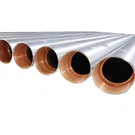


Hey there! As a supplier of 7" casing, I often get asked about the burst pressure of this type of casing. So, I thought I'd take a few minutes to break it down for you.
Let's start with the basics. Burst pressure is the maximum pressure that a casing can withstand before it fails or bursts. This is a critical factor in oil and gas drilling operations because it determines the safety and efficiency of the well. If the pressure inside the casing exceeds its burst pressure, it can lead to a catastrophic failure, which can result in environmental damage, loss of life, and significant financial losses.
So, what is the burst pressure of 7" casing? Well, the answer isn't as straightforward as you might think. The burst pressure of 7" casing depends on several factors, including the grade of steel, the wall thickness, and the diameter of the casing.
First off, let's talk about the grade of steel. There are several different grades of steel used in the manufacturing of 7" casing, each with its own unique properties and characteristics. The higher the grade of steel, the stronger and more resistant to pressure it will be. For example, P110 grade steel is stronger than K55 grade steel, so a 7" casing made from P110 grade steel will have a higher burst pressure than one made from K55 grade steel.
Next, we have the wall thickness. The thicker the wall of the casing, the more pressure it can withstand. This is because a thicker wall provides more material to resist the internal pressure. So, if you need a 7" casing with a higher burst pressure, you might want to consider one with a thicker wall.
Finally, the diameter of the casing also plays a role in its burst pressure. Generally speaking, the larger the diameter of the casing, the lower its burst pressure will be. This is because a larger diameter casing has a larger surface area, which means there is more area for the internal pressure to act on.
To calculate the burst pressure of 7" casing, you can use the following formula:
$P_b = \frac{2St}{D}$
Where:
- $P_b$ is the burst pressure
- $S$ is the yield strength of the steel
- $t$ is the wall thickness of the casing
- $D$ is the outside diameter of the casing
Let's say you have a 7" casing made from P110 grade steel with a wall thickness of 0.362 inches. The yield strength of P110 grade steel is 110,000 psi. Using the formula above, we can calculate the burst pressure as follows:
$P_b = \frac{2 \times 110000 \times 0.362}{7}$
$P_b = \frac{79640}{7}$
$P_b = 11377$ psi
So, in this example, the burst pressure of the 7" casing is approximately 11,377 psi.


It's important to note that this is just an estimate, and the actual burst pressure of a 7" casing may vary depending on a variety of factors, including the manufacturing process, the quality of the steel, and the conditions under which the casing is used.
Now, let's talk about why burst pressure is so important in oil and gas drilling operations. As I mentioned earlier, the burst pressure of a casing determines the maximum pressure that can be safely applied to the well. If the pressure inside the well exceeds the burst pressure of the casing, it can lead to a blowout, which is a sudden and uncontrolled release of oil, gas, or water from the well.
Blowouts can have serious consequences, including environmental damage, loss of life, and significant financial losses. That's why it's so important to choose the right casing for your drilling operation and to ensure that it has a high enough burst pressure to withstand the expected pressures.
At our company, we understand the importance of burst pressure in oil and gas drilling operations. That's why we offer a wide range of 7" casing options, each with its own unique properties and characteristics. Whether you need a casing with a high burst pressure for a deep well or a casing with a lower burst pressure for a shallow well, we have the right solution for you.
In addition to our 7" casing, we also offer a variety of other products, including Flow Coupling, CRA Pipe, and Slotted Casing. These products are designed to meet the specific needs of our customers and to provide them with the highest quality and most reliable solutions for their drilling operations.
If you're in the market for 7" casing or any of our other products, we'd love to hear from you. Our team of experts is available to answer your questions, provide you with more information, and help you choose the right products for your needs. So, don't hesitate to contact us today and let's start the conversation!
References
- API RP 5C5: Recommended Practice for Calculating Performance Properties of Casing, Tubing, Drill Pipe, and Line Pipe
- ASME B31.8: Gas Transmission and Distribution Piping Systems