


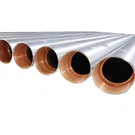


The electrical conductivity of 4" casing is a crucial property, especially in various industrial and engineering applications. As a 4" casing supplier, understanding and being able to communicate the electrical conductivity characteristics of our products is of great importance.
1. Understanding 4" Casing
4" casing refers to a tubular structure with a nominal outer diameter of 4 inches. These casings are commonly used in the oil and gas industry, water well drilling, and other underground operations. They provide structural support to the wellbore, prevent the collapse of the surrounding rock or soil, and isolate different geological layers. Besides these mechanical functions, the electrical properties, particularly the electrical conductivity, also play a significant role.
2. Factors Affecting Electrical Conductivity in 4" Casing
Material Composition
The electrical conductivity of 4" casing is primarily determined by the material from which it is made. Most casings are made of steel, which is an alloy mainly composed of iron and carbon, along with other elements such as manganese, silicon, sulfur, and phosphorus. The purity and concentration of these elements can have a substantial impact on the electrical conductivity. For example, pure iron has a relatively high electrical conductivity. However, the addition of carbon and other alloying elements to form steel can reduce the conductivity. The more complex the alloy composition, the greater the scattering of electrons, which leads to a decrease in electrical conductivity.
Heat Treatment
Heat treatment processes, such as annealing, quenching, and tempering, can also affect the electrical conductivity of 4" casing. Annealing is a process that involves heating the steel to a specific temperature and then slowly cooling it. This process can relieve internal stresses and improve the microstructure of the steel, which may increase its electrical conductivity. On the other hand, quenching, which involves rapid cooling, can create a hard and brittle microstructure, potentially reducing the electrical conductivity. Tempering after quenching can partially restore the electrical and mechanical properties of the steel.
Surface Condition
The surface condition of the 4" casing can influence its electrical conductivity. A clean and smooth surface allows for better electron flow, resulting in higher conductivity. However, if the surface is covered with rust, scale, or other contaminants, it can act as an insulator and reduce the effective electrical conductivity. Additionally, the presence of surface coatings, such as paint or galvanization, can also affect the conductivity. Galvanized coatings, which are used to protect the steel from corrosion, are typically made of zinc. Zinc has a different electrical conductivity compared to steel, and the coating can introduce a layer of resistance at the surface.
3. Measuring the Electrical Conductivity of 4" Casing
There are several methods available for measuring the electrical conductivity of 4" casing. One common method is the four - point probe technique. In this method, four probes are placed in contact with the surface of the casing. A known current is passed through the outer two probes, and the voltage is measured between the inner two probes. Using Ohm's law (V = IR), the resistance of the material can be calculated, and from the resistance and the dimensions of the sample, the electrical conductivity can be determined.
Another method is the eddy current testing. This non - destructive testing method uses electromagnetic induction to generate eddy currents in the casing. The eddy currents are affected by the electrical conductivity of the material. By measuring the changes in the impedance of the test coil, the electrical conductivity of the casing can be estimated.
4. Importance of Electrical Conductivity in 4" Casing Applications
Oil and Gas Industry
In the oil and gas industry, the electrical conductivity of 4" casing can be important for several reasons. Electrical logging tools are often used to measure the properties of the surrounding rock formations. The casing's electrical conductivity can affect the accuracy of these measurements. If the conductivity of the casing is too high or too low, it can cause interference with the electrical signals from the logging tools, leading to inaccurate data.


Moreover, in cathodic protection systems, which are used to prevent corrosion of the casing, the electrical conductivity is crucial. Cathodic protection works by creating an electrochemical cell where the casing acts as the cathode. The electrical conductivity of the casing determines how effectively the protective current can flow through the casing and the surrounding electrolyte (usually the groundwater). A casing with low electrical conductivity may not receive sufficient protective current, leading to accelerated corrosion.
Water Well Drilling
In water well drilling, the electrical conductivity of 4" casing can be relevant in applications where electromagnetic or electrical methods are used for groundwater exploration or monitoring. For example, electrical resistivity tomography can be used to map the underground water distribution. The conductivity of the casing can affect the way the electrical currents propagate through the wellbore and the surrounding ground, potentially influencing the accuracy of the resistivity measurements.
5. Our 4" Casing Products and Electrical Conductivity
As a 4" casing supplier, we offer a range of high - quality casings with carefully controlled electrical conductivity. Our casings are made from high - grade steel alloys, and we optimize the material composition and heat treatment processes to achieve the desired electrical and mechanical properties.
We also ensure that the surface treatment of our casings is carried out to a high standard. For example, our corrosion - resistant coatings are designed to minimize the impact on electrical conductivity while providing excellent protection against rust and other forms of corrosion.
In addition to our standard 4" casings, we also offer Slotted Casing, Pup Joint, and D10 Coupling options. These products are engineered to meet the specific requirements of our customers, including those related to electrical conductivity.
6. Contact for Purchase and Technical Consultation
If you are interested in learning more about the electrical conductivity of our 4" casing products or wish to discuss your specific needs, we invite you to contact us for a detailed consultation. Our team of experts is ready to provide you with comprehensive information and guidance on selecting the most suitable 4" casing for your application. Whether you are in the oil and gas industry, water well drilling, or other relevant fields, we can offer customized solutions to meet your requirements.
References
- von Karman, T. and Biot, M.A. (1940). Mathematical Methods in Engineering. McGraw - Hill.
- Kies, J.A., and Gensamer, M. (1953). "Effect of Alloying Elements on the Electrical Resistivity of Iron Alloys." Transactions of the American Institute of Mining, Metallurgical, and Petroleum Engineers.
- ASM Handbook Committee. (1981). ASM Handbook Volume 4: Heat Treating. ASM International.