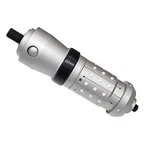
Milling with coiled tubing puts the highest torque of any routine intervention through the connector at the top of the bottomhole assembly. The external slip connector is built for that duty: the slips bite on the outside of the coil, the wedge action tightens as the pull increases, and a cross-embedded lower sub carries the torque into the tool string. When a mill stalls and the coil starts to wind up, this is the joint that decides whether the string comes back in one piece. On a milling job the crew watches the torque trace for exactly this reason: a step change usually means the connector is slipping, not that the mill has cut through.
How an External Slip Connector Grips the Coil
The connector slides over the coiled tubing and a set of buckle slips is wedged against the outer wall. The teeth bite into the pipe, and the greater the pull, the deeper the bite, so the connection tightens under load rather than relying on a friction fit. Unlike an internal connector, it leaves the full bore of the coil open, which is why it is preferred where circulation through the string matters more than a flush outside diameter. At the rig floor the connector is installed over the coil end, and the slips are seated with an overpull before the tool string is picked up.
Torque Transmission Through Wedge Slips
Torque does not pass through the slips alone. The lower end of the slip assembly and the upper end of the lower sub are cross-embedded, so the slip cage cannot rotate relative to the sub. That positive engagement is what allows the connector to transmit large torque in both directions during milling, reaming and fishing, instead of backing off when the motor reverses or the string is rocked free. That matters on a stuck mill, where the crew may work the string up and down for an hour before deciding to release.
Sizes and Thread Options
The connector covers coil from 1-1/4 inches to 2-3/8 inches outside diameter. Maximum connector outside diameter runs from 1.678 inches on the smallest size to 3.122 inches on the largest, with a minimum inside diameter from 0.75 to 1.5 inches. Threads include 1 inch AMMT, 1.5 inches AMMT, 2-3/8 inches PAC and 2-7/8 inches PAC, so the connector can be dressed to the tool below without an extra crossover. A crossover that is added to make a connector fit is one more joint to check for make-up torque on a dark rig floor.
Sealing at Pressure
The connector carries O-ring seals with backup rings, which is what makes it suitable for high-pressure work rather than only for mechanical connection. The seal sits against the outside of the coil, so the surface condition of the pipe at the connection point matters: a coil that has been mishandled or has scale on the outside will not seal, however well the slips grip. Clean the pipe, inspect for ovality, and check the seal kit before make-up. In the field, a coil that has ovality at the end is cut back rather than forced, because a seal that is distorted at installation will leak at pressure.
Inspect the seal kit and backup rings before every run.
Clean the coil surface where the slips and seals land.
Record make-up and the overpull used to set the slips.
External Slip Connector Inspection After Milling
Milling is abrasive and the connector sees the result. After the job, strip the tool and look at the slip teeth for flattening, the seal for cuts, and the cross-embedded drive faces for rounding. A connector that has been worked hard can pass a visual check at the rack and fail on the next run, so the slip set is replaced on a cycle count rather than on appearance, and the seal kit is replaced every time the tool is broken out. The crew that replaces the slips on a count rather than on appearance is the crew that stops losing strings to connector failure.
An external slip connector trades a flush profile for a full bore and a strong torque path. On a milling job that is the right trade, provided the pipe surface and the slip set are treated as part of the connection.
For more information, please contact China Vigor at info@vigorpetroleum.com or call +0086 29 81161513.