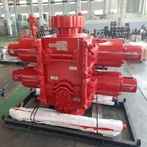
Drilling Stabilizers are crucial components used in drilling operations to center and steer drill strings in the wellbore. They have specially designed blades or rollers that contact the borehole walls to keep the drill string stable, preventing it from whipping or improperly deviating off course.
Several types of stabilizers are routinely incorporated into the drill string depending on drilling needs and well architecture. Understanding the unique stabilizer options enables drillers to select the most appropriate centering and directional control for specific drilling situations.
(1)Fixed Blade Stabilizers
The most common type of stabilizer uses fixed rigid blades that extend out to make constant contact with the borehole wall. The steady, unyielding blades center the drill pipes concentrically to prevent them from shifting off-center inside wider holes. Fixed stabilizers are positioned along straight drill string sections to keep the string rotating smoothly without vibration.
Fixed stabilizers contain tough, hardened blades uniquely shaped to reinforce the body of the tool. Deep directional drilling may utilize spiral blade patterns to enhance cement bonding within curves. Stabilizer blades are engineered to resist extreme wear given their constant contact with the abrasive well walls.
(2)Adjustable Blade Stabilizers
While fixed Drilling Stabilizers have set blade dimensions, adjustable blade stabilizers allow operators to manually or hydraulically alter the diameter of the blades. This custom sizing lets drillers actively steer by creating pressure points against the borehole.
Extending specific blades to increase localized contact applies a directional force that deflects drill strings toward a target zone. Especially useful for directional corrections, adjustable stabilizers provide precision steering control compared to fixed options.
(3)Near-Bit Stabilizers
As their name denotes, near-bit stabilizers are positioned directly above drill bits to minimize lateral vibrations that reduce drilling efficiency. Concentrating stabilizer contact by the bit buttresses torsional movements and maintains a centered rotation axis close to the cutting structure.
This proximity to the flexion point of the drill string also allows for precise trajectory control. Directional drilling relies on near-bit stabilization to put force directly behind drill bits for immediate response. Their influencing effects decline when farther upstring from the fulcrum at the drill bit.
(4)Roller Reamer Stabilizers
Instead of fixed blades, roller reamer stabilizers rotate cylindrical cutters around the tool body to actively gauge the borehole diameter. As they rotate, the rolling cutters enlarge sections of the hole that may be narrower than the pass-through diameter required by following drill string components. This reaming action while drilling ensures adequate hole clearance downstring.
The mechanical action of roller reamer stabilizers provides self-centering to keep underlying drill pipes drilling straight within the cleared hole opening. Combining hole opening and stabilization makes roller reamers ideal for use in front of high-value bottom hole assemblies to protect them when entering narrow or uneven hole sections.
Various Drilling Stabilizers designs provide tailored directional control, centering performance, and hole-opening capabilities. If you need procurement solutions, please contact us at info@vigorpetroleum.com.