
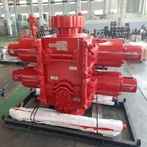
Blowout preventer (BOP) is a critical well control device installed on the wellhead casing to manage high-pressure oil, gas, and water during drilling operations. When downhole pressure is high, BOPs can completely seal off the wellbore. They feature a four-way valve below the ram, allowing for the injection of heavy mud through the drill string to displace gas-cut mud and increase hydrostatic pressure in the wellbore to control high-pressure formations.
Blowout preventer (BOP) is classified into three main types: conventional, universal (or variable bore), and rotating. Universal BOPs can be activated in emergencies to accommodate any size of drilling tool or an empty wellbore. Rotating BOPs allow for continuous drilling operations while controlling well pressure. In deep well drilling, it's common to use a combination of two conventional BOPs along with a universal and a rotating BOP, resulting in a stack of three or four preventers at the wellhead.
The Annular Blowout Preventer typically features a large gate with ram-type preventers. When activated, it creates a sealed annular space between the pipe and the wellbore. It can independently seal the well with a pipe in the hole but has limited use cycles and is not suitable for extended well shut-ins.
The blowout preventer (BOP) stack is the most crucial well control equipment, playing a vital role in drilling, especially in underbalanced operations. BOPs are designed to close the wellbore under pressure, maintain continuous well control, and circulate formation fluids out of the well.
Hydraulic BOPs primarily come in two forms: ram-type and annular. Ram-type BOPs consist of a body, side doors, hydraulic cylinders, cylinder caps, pistons, piston rods, locking shafts, seals, and rams. They operate by using hydraulic pressure to move pistons, which drive the rams to open or close the wellbore.
Ram-type BOPs feature four types of rams: blind (for full closure), pipe (for sealing around drill pipe or tubing), variable bore (for various pipe sizes), and shear (for cutting drill pipe in emergencies). Pipe rams can also suspend drilling equipment when necessary. Side outlets on the BOP body allow for mud circulation and choke-and-kill operations.
Annular BOPs are categorized as either conical or spherical based on their elastomeric sealing element shape. They primarily consist of a body, top cap, elastomeric element, and piston. Annular BOPs can seal around various pipe sizes or fully close an empty wellbore. They can also seal around non-cylindrical objects like drill collars, wirelines, or slicklines. Under certain conditions, they allow for stripping operations with the use of a pressure relief valve.
Both types of annular BOPs operate similarly. When well control is needed, high-pressure hydraulic fluid enters the closing chamber below the piston, forcing it upward. In spherical designs, the element moves up along a spherical surface, while in conical designs, the element is compressed inward by the top cap and piston's conical surface. This action constricts the element around the drill string or closes the wellbore entirely. To open the blowout preventer (BOP), the piston moves downward, and the elastomeric element returns to its original shape due to its inherent elasticity.
Vigor will provide you with a reliable solution, Please contact us at info@vigorpetroleum.com.
Contact Us
- 23 F, Building B, Zhong Tou International Building, No.10 Jin Ye I Road, High-Tech Zone, Xi'an, Shaanxi, China 710077
- info@vigorpetroleum.com
- +86-029-81161513
What Are The Types Of Blowout Preventers (BOP)?
Oct 28, 2024
You Might Also Like




Send Inquiry