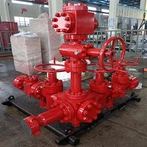
OCTG, full name Oil Country Tubular Goods, oil special pipe. Refers to a type of steel pipe specially used for oil and gas extraction, most of which are seamless pipes, but welded pipes also account for a considerable proportion.
(1) Standard: API-5CT standard drill pipe is the pipe connecting the drilling motor and the drill bit during the drilling process. The outer diameter is generally 2-6.5 inches (50-165mm), and the length is generally between 5-14m. Casing serves as the structural wall or lining of oil/gas wells to prevent contamination of the well or surrounding groundwater and can be up to 26 inches in diameter. Casing accounts for more than three-quarters of oil-specific pipe shipments.
(2) Working principle: Drilling fluid flows to the drill bit through the drill string to cool the drill bit, and at the same time, the drilled soil and rock debris and drilling fluid form mud, which is transported to the ground surface through the annular space (the gap between the casing and the drill string). Due to the harsh working environment, most drill strings are seamless pipes.
Definition of OCTG casing:
Oil pipes are mainly used for oil and gas well drilling and oil and gas transportation. It includes oil drilling pipe, oil casing, oil extraction pipe. Oil drill pipe is mainly used to connect drill collars and drill bits and transmit drilling power. The oil casing is mainly used to support the well wall during the drilling process and after the well completion, so as to ensure the drilling process and the normal operation of the entire oil well after the well completion. The oil suction pipe mainly transports the oil and gas at the bottom of the oil well to the surface.
Oil casing is the lifeline to keep oil well running. Due to the different geological conditions, the downhole stress state is complex, and the combined effects of tension, compression, bending and torsional stress act on the pipe body, which puts forward higher requirements on the quality of the casing itself. Once the casing itself is damaged for some reason, it may lead to a reduction in production of the entire well, or even scrap it. According to the strength of the steel itself, the casing can be divided into different steel grades, namely J55, K55, N80, L80, C90, T95, P110, Q125, V150, etc. Different well conditions and well depths require different steel grades. In a corrosive environment, the casing itself is also required to have corrosion resistance. In places with complex geological conditions, the casing is also required to have anti-collapse performance.
Uses of OCTG casing:
Oil casing is a large-diameter pipe that fixes the walls or holes of oil and natural gas wells. The casing is inserted into the wellbore and fixed with cement to help the wellbore separate the rock formation and prevent the wellbore from collapsing, while ensuring the circulation of the drilling mud to facilitate drilling and production.
Steel grades of oil casing: H40, J55, K55, N80, L80, C90, T95, P110, Q125, V150, etc. Processing form of casing end: short round thread, long round thread, partial trapezoidal thread, special buckle, etc. Used in oil well drilling, it is mainly used to support the well wall during the drilling process and after the well completion, so as to ensure the drilling process and the normal operation of the entire oil well after the well completion.