


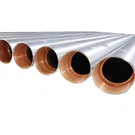


What are the Bending Resistance Properties of OCTG API Pipes?
As a trusted supplier of OCTG API pipes, I've witnessed firsthand the critical role these pipes play in the oil and gas industry. One of the most important characteristics that users often inquire about is the bending resistance properties of these pipes. In this blog, we'll delve into what makes OCTG API pipes resistant to bending and why it matters in various applications.
Understanding OCTG API Pipes
OCTG, which stands for Oil Country Tubular Goods, refers to the pipes used in the exploration and production of oil and gas. API, or the American Petroleum Institute, has established standards for these pipes to ensure their quality and performance in the demanding conditions of the oil and gas wells.
These pipes come in several types, including CRA Pipe (Corrosion Resistant Alloy Pipe), Slotted Casing, and pipes with Coupling. Each type has its own unique features, but they all need to have good bending resistance to withstand the various stresses they encounter during installation and operation.
Factors Affecting Bending Resistance
Material Composition: The material used to make OCTG API pipes is a primary determinant of their bending resistance. Typically, these pipes are made from carbon steel, alloy steel, or corrosion-resistant alloys. High-strength steels with appropriate alloying elements, such as chromium, nickel, and molybdenum, can enhance the pipe's strength and toughness, making it more resistant to bending. For example, CRA pipes are made from alloys specifically designed to resist corrosion and also offer better mechanical properties, including improved bending resistance.
Wall Thickness: The wall thickness of the pipe plays a significant role in its ability to resist bending. A thicker wall provides more material to distribute the bending stress, reducing the likelihood of deformation. However, increasing the wall thickness also increases the weight and cost of the pipe, so a balance must be struck between the required bending resistance and other factors such as transportation and installation costs.
Pipe Diameter: The diameter of the pipe affects its bending stiffness. Larger diameter pipes are generally more flexible and more prone to bending compared to smaller diameter pipes of the same wall thickness and material. This is because the moment of inertia, which is a measure of a pipe's resistance to bending, is proportional to the fourth power of the radius. Therefore, when designing a pipeline system, the diameter of the pipes must be carefully selected to ensure adequate bending resistance.
Manufacturing Process: The manufacturing process can also influence the bending resistance of OCTG API pipes. Pipes that are manufactured using high-quality processes, such as seamless pipe manufacturing, tend to have more uniform material properties and fewer internal defects, which can improve their bending resistance. Welded pipes, on the other hand, need to have well-controlled weld quality to ensure that the weld does not become a weak point under bending stress.
Importance of Bending Resistance in Oil and Gas Applications
Well Drilling: During the well drilling process, OCTG API pipes are subjected to significant bending forces as they are run into the wellbore. The wellbore may not be perfectly straight, and the pipes need to be able to bend slightly to follow the curvature of the well. If the pipes do not have sufficient bending resistance, they may deform, buckle, or even break, which can lead to costly downtime and potential safety hazards.
Pipeline Installation: In onshore and offshore pipeline installations, pipes are often bent to fit the terrain or the layout of the pipeline system. The ability of the pipes to withstand these bending operations without damage is crucial for the successful installation and long-term integrity of the pipeline. For example, in offshore pipeline laying, the pipes are bent as they are lowered from the lay barge to the seabed. If the pipes cannot handle the bending stress, it can result in pipeline failure.
Production Operations: Once the well is in production, the OCTG API pipes continue to experience bending forces due to factors such as wellbore movement, thermal expansion and contraction, and fluid flow. Good bending resistance ensures that the pipes can maintain their structural integrity over the long term, preventing leaks and other production disruptions.
Testing and Evaluation of Bending Resistance
To ensure that OCTG API pipes meet the required bending resistance standards, various testing methods are employed. These tests typically involve applying a controlled bending load to a section of the pipe and measuring the resulting deformation. The most common types of bending tests include three-point bending tests and four-point bending tests.
In a three-point bending test, the pipe is supported at two ends and a load is applied at the center. This test simulates the bending conditions that a pipe may experience when it is simply supported and subjected to a concentrated load. The four-point bending test, on the other hand, involves supporting the pipe at two outer points and applying loads at two inner points. This test is more suitable for simulating the bending conditions of a pipe under a distributed load.
The results of these bending tests are used to evaluate the mechanical properties of the pipes, such as the yield strength, ultimate strength, and modulus of elasticity. These properties are then compared to the API standards to determine whether the pipes are suitable for their intended applications.
How Our Company Ensures High Bending Resistance
As an OCTG API supplier, we are committed to providing our customers with pipes that have excellent bending resistance. We source our materials from reputable manufacturers and carefully select the alloys and grades based on the specific requirements of our customers' applications.
Our quality control team closely monitors the manufacturing process to ensure that all pipes are produced in accordance with the API standards. We conduct various inspections and tests, including non-destructive testing and bending tests, to verify the quality and bending resistance of the pipes before they are shipped to our customers.
In addition, we offer technical support to our customers to help them select the right pipes for their projects. Our experienced engineers can provide guidance on factors such as pipe diameter, wall thickness, and material selection to ensure that the pipes have the optimal bending resistance for the specific operating conditions.
Conclusion
The bending resistance properties of OCTG API pipes are crucial for their performance in the oil and gas industry. Factors such as material composition, wall thickness, pipe diameter, and manufacturing process all play a role in determining the pipe's ability to withstand bending forces. By understanding these factors and conducting proper testing, we can ensure that the pipes meet the required standards and provide reliable service in various applications.
If you are in need of high-quality OCTG API pipes with excellent bending resistance, we invite you to contact us to discuss your specific requirements. Our team of experts is ready to assist you in selecting the right products for your project and providing you with the best possible service.
References
- American Petroleum Institute. API Specification 5CT. Specification for Casing and Tubing.
- American Petroleum Institute. API Specification 5L. Specification for Line Pipe.
- ASME Boiler and Pressure Vessel Code. Section VIII, Division 1. Rules for Construction of Pressure Vessels.