


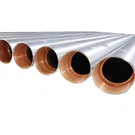


Offshore oil and gas exploration and production present a unique set of challenges that demand high - performance equipment. As a supplier of 7" casing, I understand the critical role this component plays in offshore applications and the special requirements it must meet.
1. Material and Corrosion Resistance
In offshore environments, the 7" casing is constantly exposed to harsh conditions. Saltwater, which is highly corrosive, can cause significant damage to the casing over time. Therefore, the choice of material is of utmost importance. High - grade steel alloys are commonly used for 7" casing in offshore applications. These alloys are designed to resist corrosion and maintain their structural integrity.
For example, some steels are alloyed with elements such as chromium, nickel, and molybdenum. Chromium forms a passive oxide layer on the surface of the steel, which acts as a barrier against corrosion. Nickel enhances the toughness and ductility of the steel, while molybdenum improves its strength and corrosion resistance in chloride - containing environments.
The casing also needs to withstand the effects of hydrogen sulfide (H₂S), which is often present in offshore oil and gas reservoirs. H₂S can cause sulfide stress cracking (SSC) in steel, leading to catastrophic failures. To prevent SSC, the 7" casing must be made from materials that are resistant to this type of cracking. Special heat treatments can also be applied to the casing to improve its resistance to H₂S.
2. Pressure and Structural Integrity
Offshore wells are often drilled to great depths, where the pressure can be extremely high. The 7" casing must be able to withstand these high pressures without collapsing or deforming. The design of the casing, including its wall thickness and grade, is crucial in ensuring its structural integrity.
The casing is typically rated for a specific burst and collapse pressure. The burst pressure is the maximum pressure the casing can withstand before it ruptures, while the collapse pressure is the maximum external pressure it can withstand before it collapses. These ratings are determined through rigorous testing and engineering calculations.
In addition to withstanding high pressures, the 7" casing must also be able to support the weight of the wellbore and any equipment that is installed inside it. This requires a casing with high strength and good mechanical properties. The casing should have a high yield strength, which is the stress at which the material begins to deform plastically, and a high ultimate tensile strength, which is the maximum stress the material can withstand before breaking.
3. Connection and Sealing
The connections between the sections of 7" casing are critical in ensuring the integrity of the wellbore. A poor connection can lead to leaks, which can be extremely dangerous in an offshore environment. The connections must be able to withstand high pressures and torques during installation and operation.
There are several types of connections available for 7" casing, including buttress, round, and premium connections. Premium connections are often preferred in offshore applications because they offer better sealing and higher torque capacity. These connections are designed to provide a metal - to - metal seal, which is more reliable than traditional elastomeric seals.
The Coupling used in the connection also plays an important role. It must be made from the same high - quality material as the casing and be properly machined to ensure a tight fit. The coupling should also be able to withstand the same pressure and corrosion conditions as the casing.
4. Handling and Installation
Offshore installation of 7" casing is a complex and challenging process. The casing must be designed to be easily handled and installed in the limited space available on an offshore platform. It should be lightweight enough to be lifted and moved by the available equipment, but still strong enough to withstand the rigors of installation.
The Pup Joint is an important component in the installation process. Pup joints are short sections of casing that are used to adjust the length of the casing string. They must be carefully selected and installed to ensure that the casing string is the correct length and that the connections are properly aligned.
The casing must also be able to withstand the dynamic forces that occur during installation, such as vibrations and impacts. Special handling equipment, such as casing tongs and elevators, are used to install the casing, and the casing must be designed to be compatible with this equipment.
5. Compatibility with Other Equipment
The 7" casing must be compatible with other equipment used in the offshore well, such as Tubing, packers, and valves. Compatibility ensures that the entire well system functions properly and efficiently.


For example, the inner diameter of the 7" casing must be large enough to accommodate the tubing and other downhole equipment. The casing must also be able to provide a proper seal around the packers to prevent fluid leakage between different zones in the wellbore.
The threads on the casing must be compatible with the threads on the other components to ensure a proper connection. Any mismatch in the threads can lead to leaks or difficulty in installation.
6. Environmental and Regulatory Compliance
Offshore operations are subject to strict environmental and regulatory requirements. The 7" casing must comply with these requirements to ensure the safety of the environment and the workers.
The materials used in the casing must be environmentally friendly and not pose a risk to the marine ecosystem. The manufacturing process of the casing must also meet environmental standards, such as reducing emissions and waste.
Regulatory bodies, such as the Bureau of Safety and Environmental Enforcement (BSEE) in the United States, set standards for the design, installation, and operation of offshore wells. The 7" casing must meet these standards to obtain the necessary permits for offshore operations.
Conclusion
As a supplier of 7" casing, I am committed to providing high - quality products that meet the special requirements of offshore applications. The unique challenges of the offshore environment demand a casing that is corrosion - resistant, structurally strong, and compatible with other equipment. By understanding these requirements and using the latest technologies and materials, we can ensure that our 7" casing provides reliable performance in the most demanding offshore conditions.
If you are in the market for 7" casing for your offshore project, I encourage you to contact us for a detailed discussion. We have the expertise and experience to provide you with the best solutions for your specific needs. Whether you need a standard casing or a customized solution, we can work with you to meet your requirements.
References
- API Specification 5CT, “Specification for Casing and Tubing,” American Petroleum Institute.
- Spears, M. K. (2000). Offshore Oil and Gas Production: A Nontechnical Guide. PennWell Books.
- Craig, B. (2012). Corrosion in the Oil and Gas Industry. Woodhead Publishing.