


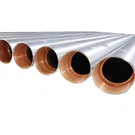


In the vast and intricate world of chemical processes, coupling plays a pivotal role. As a coupling supplier deeply entrenched in this industry, I've witnessed firsthand the diverse types of couplings and their significance. Coupling, in the context of chemical processes, refers to the connection or interaction between different components, systems, or reactions. These connections are crucial for the smooth and efficient operation of chemical plants, ensuring that materials are transferred, reactions are controlled, and products are produced with precision.
Mechanical Couplings
Mechanical couplings are among the most common types used in chemical processes. They are designed to connect two shafts together to transmit power and torque. In chemical plants, pumps, mixers, and agitators often rely on mechanical couplings to ensure that the driving force from the motor is effectively transferred to the working components.
One of the most popular mechanical couplings is the flexible coupling. This type of coupling can accommodate misalignments between the shafts, which is essential in chemical processes where equipment may experience vibrations or thermal expansion. Flexible couplings come in various designs, such as elastomeric couplings and gear couplings. Elastomeric couplings use rubber or other elastomeric materials to transmit torque while absorbing shocks and vibrations. Gear couplings, on the other hand, use gears to transmit power and can handle higher torque loads.
Another type of mechanical coupling is the rigid coupling. As the name suggests, rigid couplings provide a solid connection between the shafts, with no flexibility. They are typically used when precise alignment is possible and maintained. In chemical processes, rigid couplings are often used in applications where high-speed and high-torque transmission is required, such as in some centrifugal compressors.
Fluid Couplings
Fluid couplings are used to transmit power between two rotating shafts using a fluid medium, usually oil. In chemical processes, fluid couplings are commonly used in pump drives and conveyor systems. The principle behind fluid couplings is based on the transfer of kinetic energy from the driving impeller to the driven turbine through the fluid.
One of the key advantages of fluid couplings is their ability to provide smooth acceleration and deceleration. This is particularly important in chemical processes where sudden changes in speed can cause damage to equipment or disrupt the chemical reactions. Fluid couplings also offer overload protection. When the load on the driven shaft exceeds a certain limit, the fluid coupling slips, preventing damage to the motor and other components.
Electrical Couplings
In modern chemical processes, electrical couplings are becoming increasingly important. These couplings are used to connect electrical circuits, components, or systems. For example, in control systems, electrical couplings are used to transmit signals between sensors, actuators, and controllers.
Transformer couplings are a type of electrical coupling commonly used in power distribution systems in chemical plants. They are used to step up or step down the voltage, ensuring that the electrical equipment receives the appropriate voltage for operation. Capacitive and inductive couplings are also used in signal transmission applications, allowing for the transfer of electrical signals without direct electrical contact.
Chemical Couplings
Chemical couplings involve the connection or interaction between different chemical species or reactions. In chemical synthesis, coupling reactions are used to form new chemical bonds between molecules. For example, in the production of polymers, coupling reactions are used to link monomers together to form long chains.
One well-known type of chemical coupling reaction is the Heck reaction. This reaction is used to form carbon-carbon bonds between aryl or vinyl halides and alkenes. The Heck reaction has been widely used in the pharmaceutical and agrochemical industries to synthesize complex organic molecules.
Another important chemical coupling reaction is the Suzuki reaction. This reaction involves the coupling of an organoboron compound with an organohalide or triflate in the presence of a palladium catalyst. The Suzuki reaction is known for its mild reaction conditions and high selectivity, making it a valuable tool in organic synthesis.
Instrumentation Couplings
Instrumentation couplings are used to connect various instruments and sensors in chemical processes. These couplings ensure accurate measurement and control of process variables such as temperature, pressure, flow rate, and composition.
For example, in a flow measurement system, a Flow Coupling is used to connect the flow sensor to the process pipeline. The coupling must be designed to minimize leakage and ensure that the flow measurement is accurate. Similarly, in temperature measurement systems, thermocouples or resistance temperature detectors (RTDs) are connected to the process using appropriate couplings to ensure reliable temperature readings.
Pipeline Couplings
Pipeline couplings are essential for connecting different sections of pipelines in chemical plants. They are used to ensure a leak-free connection and to accommodate thermal expansion and contraction of the pipes.
Line Pipe couplings are commonly used for transporting fluids over long distances. These couplings must be able to withstand high pressures and harsh environmental conditions. CRA Pipe couplings, on the other hand, are used for corrosion-resistant applications. They are made from materials such as stainless steel or other corrosion-resistant alloys to prevent the pipes from corroding due to the chemical nature of the transported fluids.
Selecting the Right Coupling
Selecting the right coupling for a specific chemical process is crucial. Several factors need to be considered, including the type of equipment, the operating conditions, the required torque or power transmission, and the degree of misalignment.
For mechanical couplings, factors such as the speed, torque, and type of misalignment (angular, parallel, or axial) must be taken into account. In fluid couplings, the load characteristics, the required acceleration and deceleration rates, and the efficiency of the coupling are important considerations.
In electrical couplings, the type of electrical signal, the voltage and current requirements, and the electromagnetic compatibility must be considered. For chemical couplings, the reaction conditions, the selectivity of the reaction, and the availability of reagents are key factors.
The Role of a Coupling Supplier
As a coupling supplier, my role is to provide customers with the right couplings for their specific needs. I work closely with chemical plant operators, engineers, and designers to understand their requirements and recommend the most suitable couplings.
I also offer technical support and expertise to ensure that the couplings are installed and maintained correctly. This includes providing installation instructions, troubleshooting guides, and training on the proper use and maintenance of the couplings.
In addition, I keep up-to-date with the latest developments in coupling technology. This allows me to offer customers the most advanced and efficient couplings available on the market, helping them to improve the performance and reliability of their chemical processes.
Conclusion
In conclusion, the types of coupling in chemical processes are diverse and each plays a unique and important role. From mechanical and fluid couplings for power transmission to chemical couplings for synthesis and instrumentation couplings for measurement and control, the proper selection and use of couplings are essential for the success of chemical plants.
As a coupling supplier, I am committed to providing high-quality couplings and excellent service to my customers. If you are in the chemical industry and are looking for the right couplings for your processes, I encourage you to reach out to me. I would be more than happy to discuss your requirements and assist you in finding the perfect coupling solutions. Let's work together to ensure the smooth and efficient operation of your chemical processes.


References
- Perry, R. H., & Green, D. W. (Eds.). (1997). Perry's Chemical Engineers' Handbook. McGraw-Hill.
- Smith, M. B., & March, J. (2007). March's Advanced Organic Chemistry: Reactions, Mechanisms, and Structure. Wiley.
- Shigley, J. E., Mischke, C. R., & Budynas, R. G. (2004). Mechanical Engineering Design. McGraw-Hill.