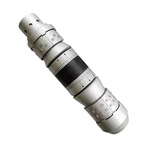
A plug-and-perf stage ends with a decision that shows up weeks later: how the plug is removed. Milling composite plugs costs rig time, and on a long lateral the coiled tubing work can dominate the completion budget. The dissolvable frac plug with a ball in place removes that decision from the schedule. The plug isolates the stage, then degrades in the well fluid, and the well is produced through a bore that no mill has to open.
What a Dissolvable Frac Plug Leaves Behind
Both the body and the element are made from degradable metal, so nothing has to be drilled out and no rubber remains to interfere with later intervention. A central production channel lets the well flow through the plug while dissolution is already under way, which is the practical difference between this design and a soluble plug that must be drilled or washed out. If a stage does need mechanical removal, the plug can still be milled with standard tools, so the completion engineer keeps a fallback that does not depend on the chemistry working perfectly. The element is the part that decides temperature behaviour; a design that degrades the sealing rubber as well as the body avoids the residue problem that shows up when only the metal dissolves.
Casing Sizes and Pressure Ratings
The ball-in-place family covers 4.5 inch, 5 inch and 5.5 inch casing. Maximum outside diameter runs from 3.5 to 4.173 inches, minimum inside diameter from 0.905 to 1.102 inches, and overall length is 12.205 to 12.598 inches. The frac ball is 1.26 to 1.496 inches depending on size. Pressure rating is 10,000 psi (68.9 MPa) differential, held for at least 48 hours at 90 to 120 degrees C, which covers the pump schedule of a normal stage rather than only the instant of breakdown.
Running Speed in Vertical and Horizontal Sections
Wireline speed is where plugs are damaged before they ever see pressure. In the vertical section the recommended limit is 500 feet per minute, dropping to 100 feet per minute as the tool approaches fluid level, because the lubricator and the fluid column change the shock load on the setting sleeve. In the lateral, faster is generally better as long as line tension stays inside the wireline limit; pumping at up to 16 barrels per minute helps move the plug to depth, starting at 2 barrels per minute through the curve and building in steps. Handling at surface matters as much as speed downhole: lift the lubricator with a plug cart or tension cart, and keep the weight of the gun string off the plug while it is being stabbed into the wellhead.
Setting Sequence and Overpull Records
Setting is a measurement, not a gesture. Pull tension into the wireline before the charge fires, record the overpull, and compare it with the reading after setting. If the numbers match the expected signature, the plug has set and the tool has released. Going back downhole to check the plug is the one move that turns a good set into a damaged element, because the setting tool cannot re-stab a plug that has already expanded.
Record overpull before and after setting on every stage.
Do not run back in to confirm the set; confirm it with pressure later.
Flush the wellbore before each plug to clear sand from the previous stage.
Dissolvable Frac Plug Dissolution Timing
Dissolution is temperature-driven, so the job plan has to use the bottomhole temperature rather than a generic figure. At 90 to 120 degrees C the plug holds differential for 48 hours and is fully dissolved within about 7 days. In cooler wells the same plug takes longer, which is acceptable when the well is not scheduled to produce immediately. Where a faster breakdown is needed, filling the wellbore with 3 percent KCl after the job accelerates the process without a mechanical run. The operator who plans the wait gets the benefit; the one who plans on a fixed number gets a plug in the way of the next stage.
The value of a dissolvable frac plug is not that it disappears, but that the completion program no longer has to schedule a mill-out. Set it cleanly, log the overpull, and let the well fluid finish the job.
For more information, please contact China Vigor at info@vigorpetroleum.com or call +0086 29 81161513.