
Latest Products

Contact Us
- 23 F, Building B, Zhong Tou International Building, No.10 Jin Ye I Road, High-Tech Zone, Xi'an, Shaanxi, China 710077
- info@vigorpetroleum.com
- +86-029-81161513
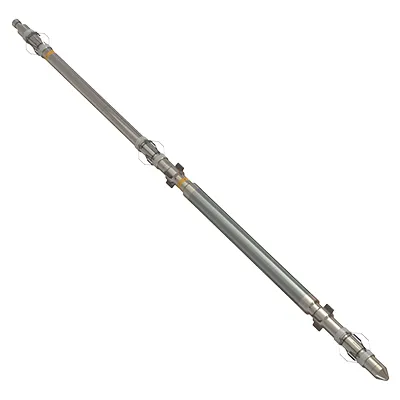
Vigor Borehole Nuclear Magnetic Resonance (VNMR)
Vigor Borehole Nuclear Magnetic Resonance (VNMR) is an imaging logging tool that employs a centralized measurement mode in the borehole.
The downhole instrument mainly consists of a probe, an electronics cartridge, and a capacitor cartridge. The tool utilizes the nuclear magnetic resonance phenomenon to measure spin-echo trains from the formation, providing information such as formation porosity, pore size distribution, permeability, and fluid properties.
It is a powerful tool for evaluating complex lithology and unconventional oil and gas reservoirs.
Description
China Vigor Drilling Oil Tools And Equipment Co., Ltd. is one of the most professional manufacturers and suppliers of vigor borehole nuclear magnetic resonance (vnmr) in China, featured by competitive price and fast delivery. Welcome to buy high quality vigor borehole nuclear magnetic resonance (vnmr) in stock here from our factory.
Nuclear magnetic resonance logging is currently the only logging method capable of measuring reservoir pore structure.
The obtained pore size distribution can be used to further evaluate critical geological parameters such as reservoir porosity, permeability, and the saturation of bound fluid and movable fluid.
In addition to leveraging the relaxation characteristics of hydrogen nuclei in pores, information such as the polarization rate of hydrogen nuclei in an external static magnetic field and their diffusion rate within pores can be used to qualitatively identify reservoir fluid types and quantitatively evaluate fluid viscosity.
This is known as two-dimensional or multi-dimensional nuclear magnetic resonance logging.
Multiple measurement modes can be performed in a single trip, simultaneously acquiring standard T2 spectrum, shifted spectrum, differential spectrum, and other signals, which both increases logging speed and provides more logging information.

Working principle

The Nuclear Magnetic Resonance Imaging Logging Tool uses the principle of Nuclear Magnetic Resonance (NMR) to measure formation porosity and provides information on the component fractions of total porosity, such as clay-bound water, capillary-bound water, and movable fluid. By analyzing and calculating the measured results, important reservoir parameters can be obtained, including permeability and the type and volume of fluids (oil, gas, water) within the movable fluid space.
VNMR spin-echo measurement consists of a series of alternating transmission/echo pulse sequences. The RF antenna, located in the static magnetic field B0, serves both to transmit RF pulses and to receive the induced spin-echo signals. During measurement, VNMR requires no radioactive source, and the instrument itself contains no radioactive source of any kind.
Product Composition
A complete VNMR logging tool set includes logging software, surface system, depth system, downhole tool, and various accessories.
logging software
The logging software for the tool can be CLASS software or INSITE software, which can be installed on a laptop for portable surface use. The CLASS software logging data formats are .cls and .m.cls.

surface system
The portable VH-2000 surface system developed by Vigor can be interfaced with all conventional DITS system logging tools and imaging logging tools owned by Halliburton, including the MRIL-P nuclear magnetic resonance logging tool.
The main panels of this system are integrated into two portable chassis. The main chassis includes the D4MP communication interface panel, 820 thermal plotter, TPS panel, and ELGAR variable frequency power supply. The auxiliary chassis includes the DCCP DC control panel and four DC power supplies.

Depth System: SDDP
The SDDP depth system used by the MRIL-P logging tool comes in models SDDP-B, SDDP-E, or SDDP-F.

Downhole Tool
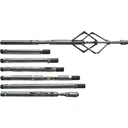
VNMR Downhole tool consists of three main parts:
- Probe (MRSN)
- Electronics Cartridge(MREC)
- D-Series Capacitor Cartridge (MRCC)


Features
- High Resolution (Provides high-resolution geological information to help determine parameters such as rock type, porosity, and permeability.)
- Non-invasive (Compared to conventional logging methods, NMR logging technology requires no sampling, thus causing almost no damage to the formation.)
- Wide Applicability (Can be applied not only to oil and gas exploration but also to water resource surveys and underground storage research.)
- Real-time Monitoring (Provides real-time geological information to assist in real-time drilling engineering adjustments.)
- Enables quantitative determination of effective porosity, free fluid porosity, bound water porosity, pore size distribution, and permeability parameters;
- Measurement results are unaffected by mud, mudcake, and invasion;
- Wide range of applications: During oilfield waterflooding development, it can be used to determine the degree of water flooding, displacement efficiency, remaining oil saturation, pay zone properties, recoverable reserves, and recovery factor;
- In complex lithologies such as carbonate and igneous rock reservoirs, and in low-porosity, low-permeability, low-resistivity reservoirs, it aids in identifying gas zones and distinguishing oil/gas contacts. It provides powerful information for the comprehensive evaluation of fractured oil and gas reservoirs.
Techinical Parameter
Dimensions and Limits
|
Max. Operating Temperature |
350°F / 177°C |
||
|
Max. Operating Pressure |
20,000 psi |
||
|
Max. Torque |
1000 ft·lbs |
||
|
Max. Compressive Strength |
37,000 lbs |
||
|
Max. Tensile Strength |
32,000 lbs |
||
|
Probe O.D. |
Length |
Weight |
|
|
6 In. |
52.88 ft |
1475 lbs |
|
Borehole Conditions
|
Tool O.D. |
Borehole Size |
|
|
6 In. |
Min. |
Max. |
|
7 In. |
16 In. |
|
| Open Hole Only | ||
| Borehole Fluid | No restriction, any drilling fluid or air | |
| Borehole Irregularity Effect | No effect outside the area of response | |
| Mudcake Effect | No effect outside the area of response | |
| Mud Resistivity Lower Limit | 0.02 ohm·m (with suitable mud excluder) | |
| Tool Position |
Centralization is ideal, with the tool centerline within ±0.5 In. of the borehole centerline. It requires standoffs and centralizers for proper centralization. |
|
Hardware Characteristics
| Signal Type | Magnetic Resonance Signal 500 kHz – 800 kHz |
| Sensor Type | Tuned RF Coil and Permanent Magnets |
| Sampling Rate | Programmable or user-adjustable |
| Telemetry System | Compatible with DITS system |
| Combinability | TBD |
Measurement Accuracy
|
Principle |
Measurement Range |
|
|
Porosity |
Nuclear Magnetic Resonance |
0-100 PU |
|
Free Fluid Index |
0-100 PU |
|
|
Bound Water Volume Porosity |
0-100 PU |
|
|
T2 Distribution |
0.5msec-0.3sec |
|
| Accuracy | +/-1 PU or 5%, whichever is greater | |
| Repeatability | Standard deviation of 1 PU in porosity measurement | |
| Vertical Resolution |
6 ft in Standard Mode 4 ft in High-Resolution Mode 2 ft in Stationary Mode |
|
Electrical Specifications
| Cablehead Voltage | 60 Hz,120 VAC +/- 18 VAC |
| Tool Current | 400 mA |
| Transmitter Power | Average less than 1.5 kW |
| Transmitter Voltage | +/-300 VDC at Cablehead |
| Transmitter Current | Max. 3A |
Rm Minimum Limits
|
Excluder O.D. (In.) |
Borehole Size (In.) |
Rm Min. Limit (ohm·m) |
|
6.875 |
7.875 |
0.02 |
|
6.875 |
8.5 |
0.025 |
|
7.25 |
8.5 |
0.02 |
|
7.25 |
9.625 |
0.035 |
|
7.25 |
10.75 |
0.05 |
|
7.25 |
12.25 |
0.065 |
|
9.0 |
10.75 |
0.02 |
|
9.0 |
12.25 |
0.04 |
Note: These values are based on operation with a 4-core power drive and a maximum cable length of 25,000 ft.
Telemetry and Gamma Logging Sonde Technical Specifications
Dimensions and Limits
|
Max. Operating Temperature |
350°F / 177°C |
||
|
Max. Operating Pressure |
20,000 psi |
||
| Max. Borehole Size | 27 In. | ||
| Min. Borehole Size | 4.5 In. | ||
|
Max. O.D. |
Length |
Weight |
|
| 3.63 In. | 7.2 ft | 110 lbs | |
Borehole Conditions
| Borehole Fluid | Salt Water, Fresh Water, Oil and Gas |
| Recommended Maximum Logging | 60 ft/min. |
| Tool Position | Centralized or Eccentered |
Hardware Characteristics
| Sensor Type | Scintillation Gamma Detector, Z-Axis Analog Accelerometer |
| Number of Sensors | 2 |
| Sampling Rate | 4 or 12 samples/ft |
| Max.Upload Data per Frame | 640 words/frame (max.) |
| Telemetry System | Compatible with DITS system |
| Combinability | All DITS tools |
Electrical Specifications
|
Cablehead Voltage |
60 Hz, 120 VAC |
Measurements
| Principle | Natural Gamma Ray |
| Measurements Range | 0 - 1000 API |
| Vertical Resolution | 0-36 In. (Standard); 12 In. (Enhanced) |
| Depth of Investigation | 4 In. (50%); 11 In. (90%) |
| Sensitivity | Acc = 3.1 V/g = ±5% or ±7% API (whichever is greater) |
| Accuracy | 1% of tool movement |
| Main Curves | Gamma Ray, Z-Axis Acceleration |
| Auxiliary Curves | None |
Calibration
| Primary Calibration | API Calibration Pit |
| Secondary Calibration | Yellow Jacket (Thorium Blanket) |
| Field Calibration | Yellow Jacket (Thorium Blanket) |
Physical Strength (Tool Connections)
| Tensile Strength | 150,000 lbs |
| Compressive Strength | 150,000 lbs |
| Torque | 600 ft·lbs |
Hot Tags: vigor borehole nuclear magnetic resonance (vnmr), China, manufacturers, supplier, in stock, API, oilfield, buy, competitive price, high quality, fast delivery, look for, Solid state Gyro, Withstand Harsh Downhole Conditions, Internal Memory, Precise Wellbore Positioning, open hole logging, Deployed By Slickline Unit
You Might Also Like


